
Hida Takayama Ultramarathon
Race report 24: North Face Geopark Series

14th Hida Takayama Ultramarathon (第14回 飛騨高山ウルトラマラソン)
Before running this ultramarathon I wrote an article called Exploring the Hida Takayama Ultramarathon Course. A breakdown of the course is in that article so if you want more granular details please check that article (people who want to run the Hida Takayama Ultramarathon in the future may find both these articles useful). This race report will focus on my experience with the race.
This race is part of a series of five races. I ran the Challenge Fuji 5 Lakes Ultramarathon two years ago and wrote a report about the experience. Last year I ran the Nobeyama Ultra marathon and wrote a report about that one as well. Continuing this theme, this is a report about the Hida Takayama Ultramarathon. As such, it will follow a similar structure to the previous ones.
Booking logistics
Last year in November I was convinced that I’d missed the boat on the entry for this ultramarathon. I’m not sure if it opened, closed, then opened for a second round, but to cut a long story short, the ultramarathon opened on December 24th at around 18:00.
I wanted to make sure I had somewhere to stay so as soon as the hotels opened for the race I booked one. (My reservation number was 000002. Guess that means I was the second person to reserve a hotel). When I took part in Challenge Fuji 5, and Nobeyama, I had a shared room, but this time I managed to secure a single room.
I knew the race booking would be around for longer than the hotel booking so I booked the race right after booking the hotel. I also managed to secure a T-Shirt for being within the first 2,500 applicants.
The following day I received an email saying that T-shirts were no longer available, so the race really filled up fast this year. If you want a race T-shirt booking right away is key for this one.
The day before the race
Skipping ahead to June 2026, I had two options to get to the race. I could have gone by train myself, or catch a ride with a friend of mine. I ended up doing the latter so I took an early train to Tokyo then went by car to the Takayama area. The drive from Tokyo took about 5 hours. This was much further way than the previous ultras I had done before.
My hotel wasn’t actually close to the start area and was kind of out of town. I booked a taxi via the Uber App in advance but when I got to the hotel I found that there was a shuttle bus to take us to “Big Arena,” so I canceled the taxi and secured a place on the shuttle.
For the rest of that day, I took a bus into Takayama, did a bit of sightseeing in the area, bought some food for the evening, took a bath in the hotel 温泉 (onsen: hot spring) then went to bed at around 7am.
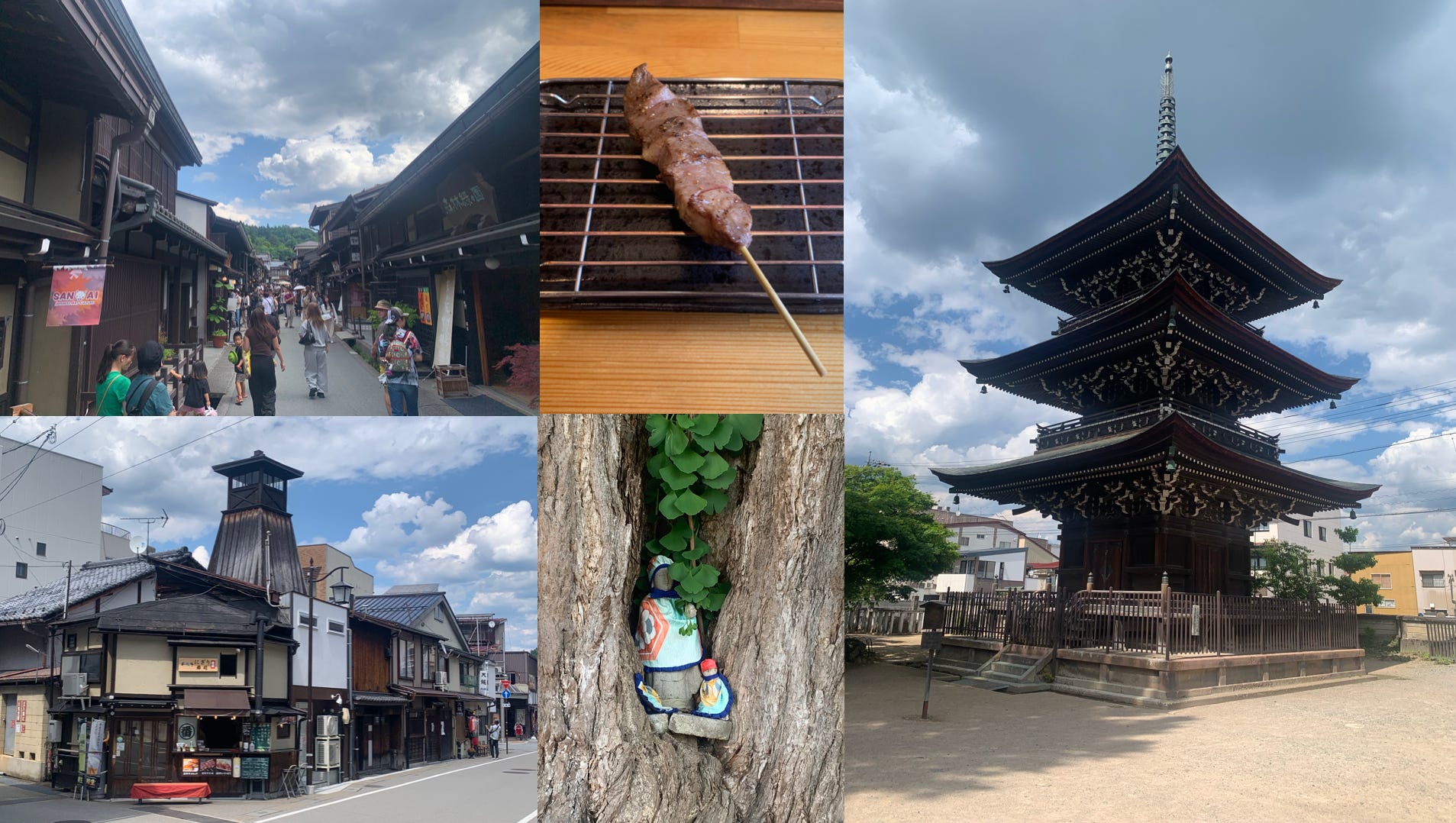
There were no meals in the hotel package that I booked, but this meant I could deal with things at my own pace. I missed a bit of the “travel” experience in this race, but thanks to having a single room and being able to determine my own schedule, I actually slept very well and was ready to go on the morning of the race.
Race day breakdown
Like with my Nobeyama race breakdown, I’m separating this report by 関門 (kanmon: checkpoints). The checkpoints in these races are very strict. If you don’t make them in time you get a DNF (did not finish) status.
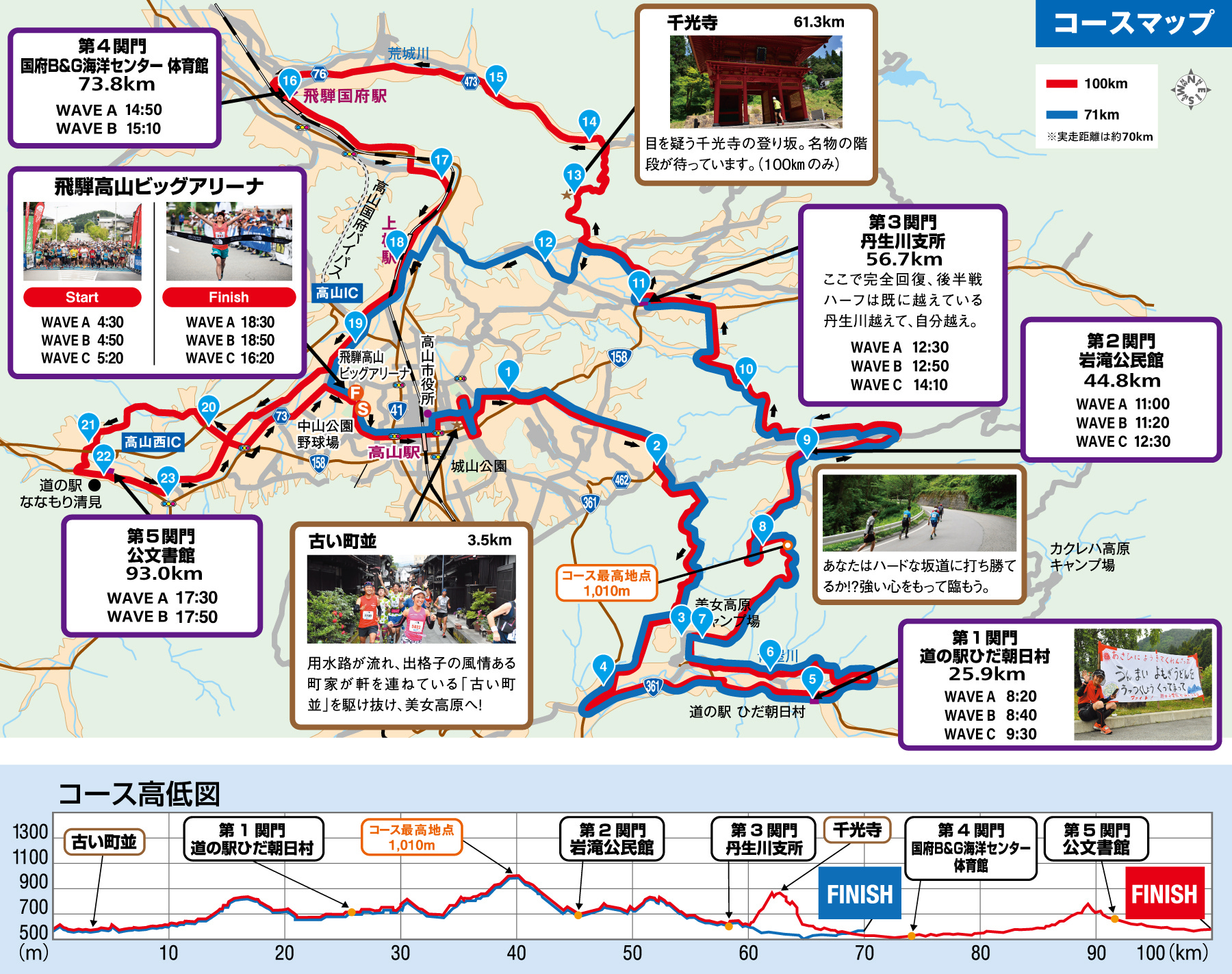
As with the previous report, I’m putting this report together using posts from 𝕏, photo metadata, and memory.
Start to Checkpoint 1 (0 – 25.9 km)
道の駅ひだ朝日村 : Michi-no-Eki Hida Asahi Village
I got the shuttle bus from my hotel at 03:30 and arrived at Hida Takayama Big Arena at about 03:45. My wave started at 04:30 so I had plenty of time to use the restroom and take in the atmosphere. I probably wouldn’t have had time to use the restroom if I hadn’t gone right away because there was a MASSIVE line right before we got started. Still, race nerves started taking over (as they tend to do) so I thought I’d use one of the early ones on the course once we got started.
We gathered at the start area about 15 minutes before everything kicked off and then, after a few speeches, set off into the foggy morning.
The beginning of the race started with an easy uphill segment then had us running down a steady descent into the Takayama city area. It felt very much like any other road marathon at this point. I was running with a friend of mine at this point and we both noted that maybe we were going out a bit quick, but the pace felt right as the adrenaline was flowing at the beginning of the race.
I stopped at a Temple restroom (from the pagoda I visited the day before) on the course just before we headed into the old streets of Takayama. This was actually quite a good way to get me to slow down a little bit as we set off.
The atmosphere from the old town onwards was fantastic. What was a street full of tourists the previous day turned into a street full of runners. The shopkeepers and other locals came out to cheer everyone on, even at that very early time of the day. It was stunning to run towards the foggy mountains through the old town, and although it was a bit jarring, it was also amazing to pass a guy with a speaker set playing “Eye of the Tiger” at full blast before it was even 5 am. (I’m sure the locals could forgive this one day a year).
As we set off into the mountains the streets were still lined with locals cheering us on. There were even elderly people that had shuffled out to sit on their roofs to cheer us on. There was a real festival atmosphere the entire way.
We got to the fist aid station at 5.9 km (高山信用金庫 三福寺支店 (Takayama Shinkin Bank, Sanfukuji Branch)), but only stopped very briefly to rehydrate. There were a lot of trafic signals in the first part of the race. That story was repeated at the aid station at 10.7 km (塩屋公民館 (Shioya Community Center)), but after that point there was quite a large hill to climb.
The hilly section started steadily enough, and we were treated to the view of the sunrise as we climbed.
I try to pace myself on climbing hills during these ultras because I know that there is a long path ahead. I am however, quite quick on the downhill segments. Once we reached the top of the hill I charged down to the 16.7 km (美女高原 (Bijo Highlands)) aid station, where I had again, I quickly rehydrated, and then set off at a steady run to the next aid station.
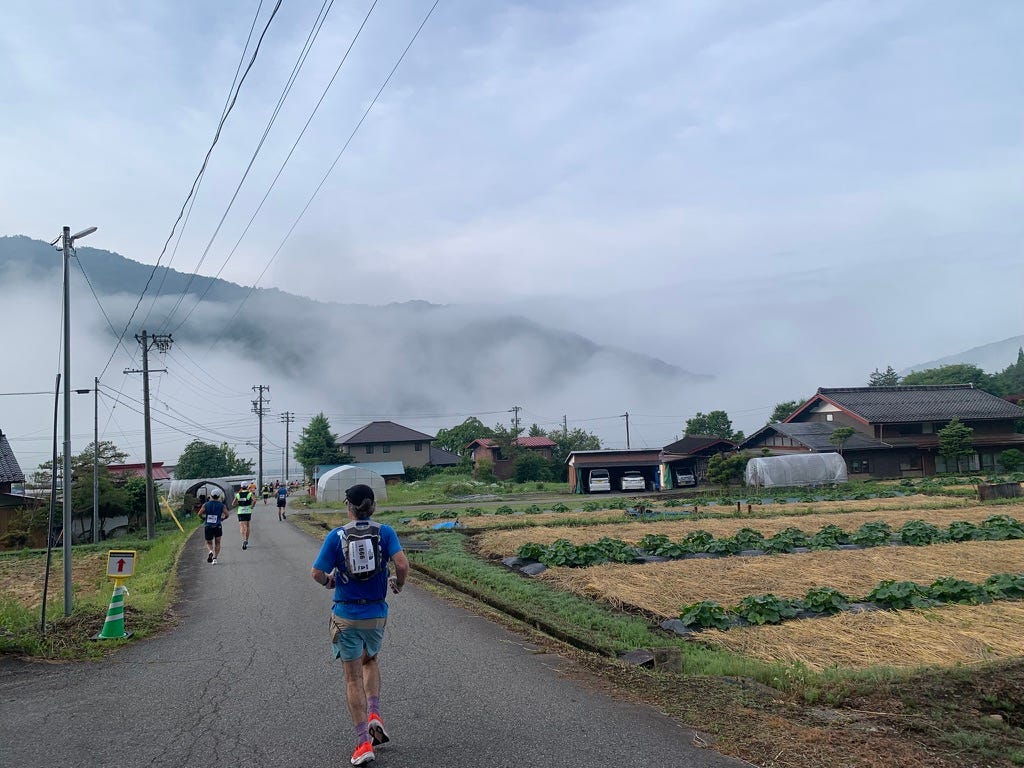
Leading up to the next aid station was a beautiful farm area, where it looked like we were running into clouds. We weren’t that high up, so it was difficult to tell if it was fog or clouds, but the effect was stunning.
The 19.6 km aid station( 飛騨高山ワインアポセカリー(旧ひまわり農園前) (Hida Takayama Wine Apothecary, former Himawari Farm site)) went by without much notice (mostly just rehydrating) and I then just charged on towards the first checkpoint, still running with my friend.
At this point in the race I was starting to think that maybe I had gone out a bit too fast and that I wasn’t eating enough. I was relying almost totally on drinking coke, sports drink, and that citric acid drink, without actually taking in many calories on the way. But when we got to the first checkpoint we were able to take a bit of a break.
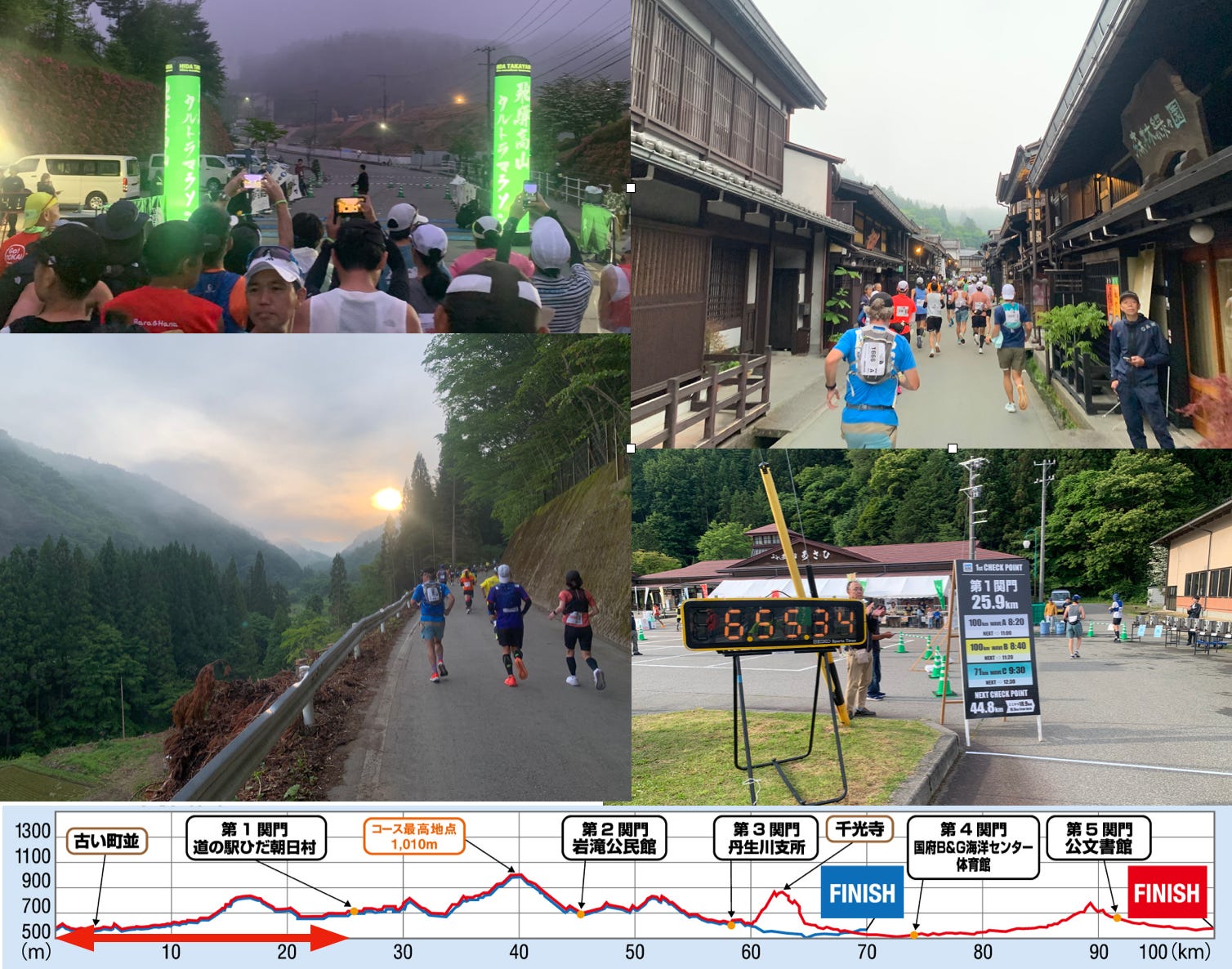
We were 2 hours 25 minutes ahead of the closing time of this checkpoint.
Checkpoint 1 to Checkpoint 2 (25.9 – 44.8 km)
岩滝公民館 : Iwataki Community Center
At the first checkpoint I took a bit of time to try to force some food down. The aid station was giving out よもぎうどん (yomogi udon), which is a kind of green noodle dish made out of mugwort. It was cool, refreshing, and went down pretty easily. Beyond that I was just refueling on pretty much a liquid diet. I was still functioning without any issues (which is good because I was only a quarter of the way into the ultra), so that was a bonus.
I gave a high five to someone dressed as a giant corn cob and then continued on my way.
The next section of the course was significantly hillier than the previous one. I paced myself as much as possible on the hills but I still wanted to keep a good pace going, so my run walk strategy was used quite a lot.
Going up the hills I came across a few people dressed as dinosaurs which was very much a pick me up.
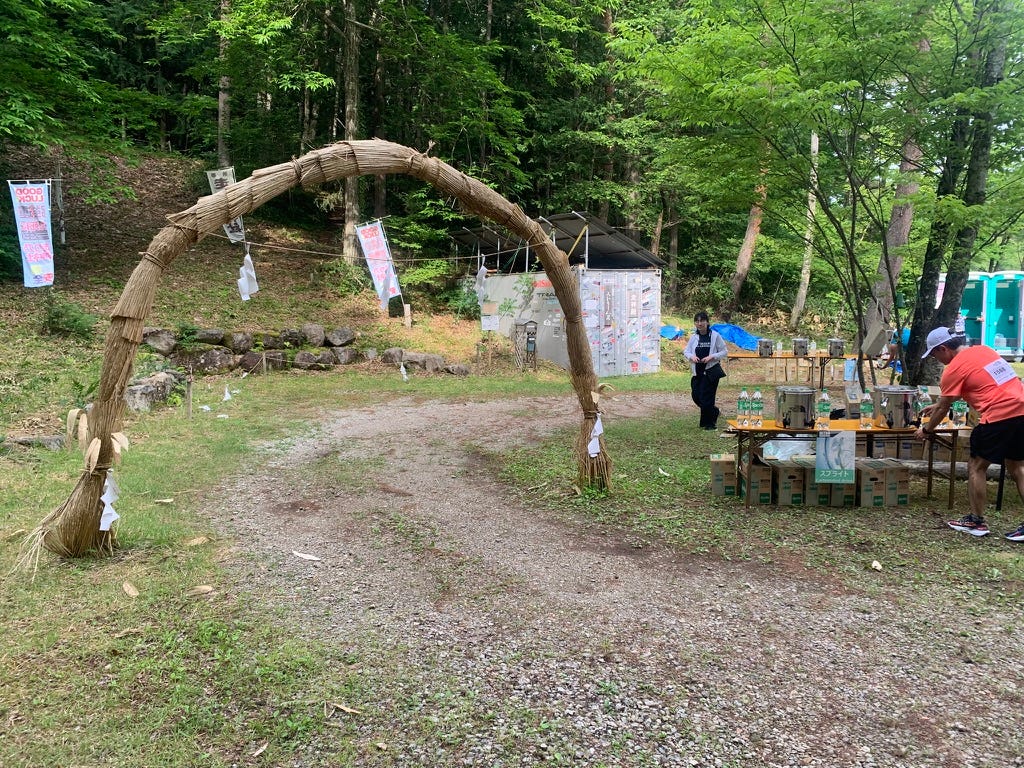
At around 35.1 km I came to an aid station called 走り乃神社 (Hashiri-no Shrine). There were arches at this aid station made of straw which added to the mysterious appeal of this point. It was also a bonus that they were giving out Shonan Gold Energy (a kind of Japanese version of Red Bull but made out of Shonan Gold oranges), so that was a very welcome pick me up.
There was quite an extensive climb after this up to roughly the 40 km point. It was there that I saw a sign for the highest point of the course. This point was much lower than the one in Nobeyama but it came at the half way point of the course instead of nearer the start like Nobeyama. The approach felt a bit different.
When I ran down that slope after the highest point I saw a cone that pointed out 42.195 km and yelled MARATHON as I passed it. That seemed to turn a few heads, but I didn’t care. Once you cross a marathon you are officially in ultra territory.
The next aid station came shortly after this at 44.8 km.
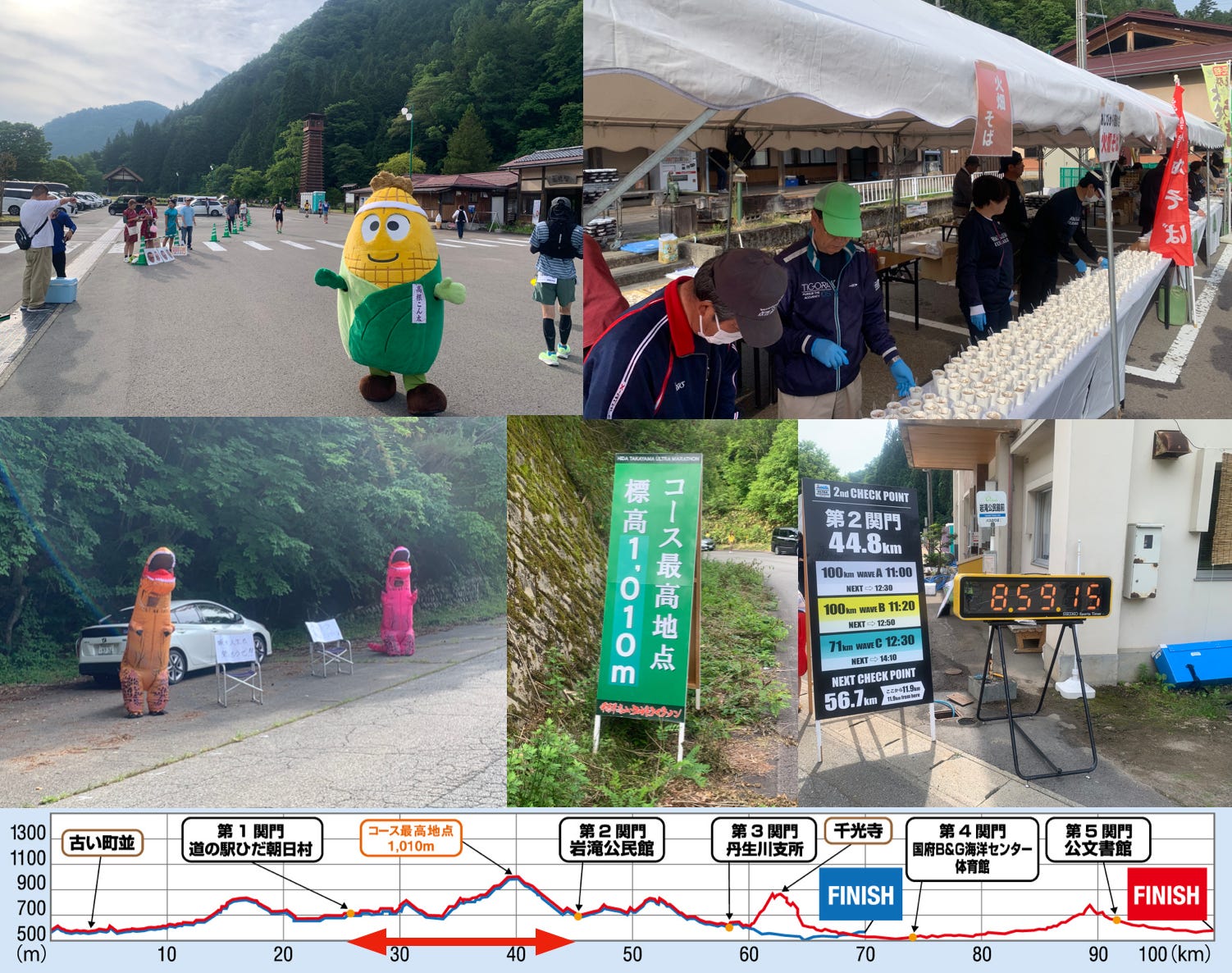
I arrived at this aid station right before 9am, meaning I was 2 hours ahead of the closing time of this checkpoint.
Checkpoint 2 to Checkpoint 3 (44.8 – 56.7 km)
丹生川支所 : Nyūkawa Branch Office
At the second checkpoint I again, refueled mostly with liquid calories. It was also getting pretty hot despite it being quite early in the morning. Thankfully at the aid stations there were plenty of buckets filled with cold water that we were able to dump over ourselves to cool off. Right before I set off I asked a volunteer to pour water on the back of my neck to try to regulate my temperature. This helped a bit but it needed to be a regular occurrence at every aid station moving forward.
The next section of the course had us passing through more gradual inclines and descents. Once again, I did my best to run-walk the climbs and simply let gravity take over during the descents.
During this section of the course I was going up a steady hill and saw a banner the locals had put up:
あなたの走る姿に感動!岩滝の住民より
Anata no hashiru sugata ni kandō! Iwataki no jūmin yori
"We are moved by the sight of you running - From the residents of Iwataki"
This was a really big boost to my morale as I climbed that particular slope.
After that section there was a long descent down to checkpoint 3 at 丹生川支所 (Nyūkawa Branch Office). There was a real party atmosphere going in this particular area that you could hear from across the street.
I could see and hear the checkpoint but I needed to go underground to cross the road before resurfacing at the other side and crossing into the checkpoint area.
This checkpoint was great. I ate some トマトそうめん (Tomato sōmen) and some other food at this aid station, but I unfortunately missed the Hida beef. (I just didn’t see it. Thankfully I’d eaten some the previous day so didn’t totally miss out on the experience).
There was a statue of 両面宿儺 (Ryomen Sukuna) in front of the hall. Ryomen Sukuna is a legendary, multi-limbed figure who existed in two entirely contrasting forms: a monstrous outlaw and a regional folk hero. He is famously mentioned in the 日本書紀(Nihon Shoki: Chronicle of Japan). This character is more popularly recognized in the anime series 呪術廻戦 (Jujutsu Kaisen).
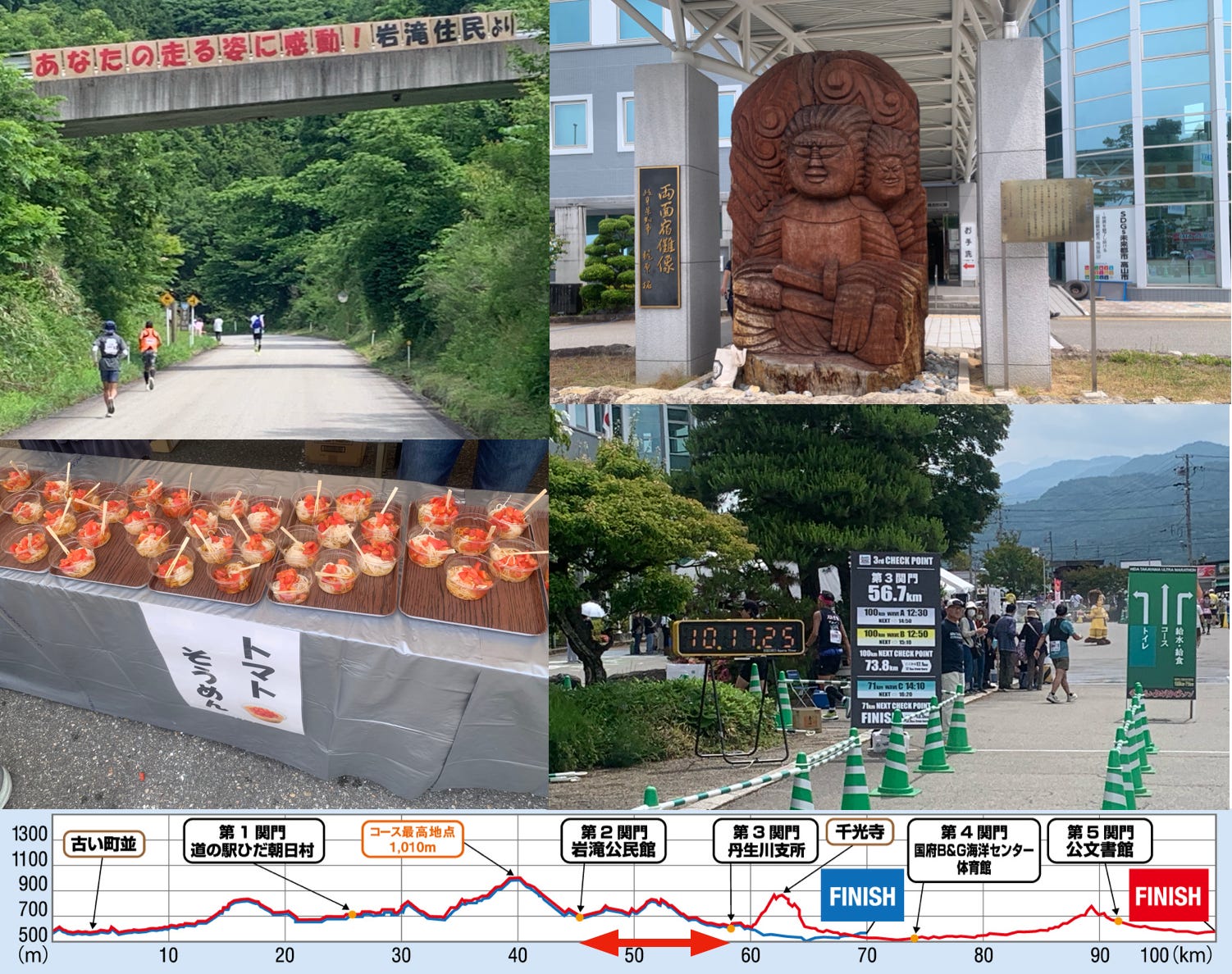
I arrived at this checkpoint at 10:17, meaning I was just over 2 hours 10 mins ahead of the closing time of this checkpoint.
Checkpoint 3 to Checkpoint 4 (56.7 – 73.8 km)
国府B&G海洋センター : Kokufu B&G Marine Center
The next part of the course was quite special to me. It started off with a sligth downhill section followed by an intense climb.
I am generally quite good at intense climbs because I’m quite a good power hiker. Almost everyone walked in this section but my walking stride meant I wasn’t hindered much by the incline.
I ended up talking to another runner on the way up the hill. It was his first 100K and he was doing very well. As we were climbing and chatting we commented that being able to keep going while talking is actually quite good for breathing regulation.
When we got near the top of the hill we started hearing music. Once 千光寺 (Senkōji Temple) was in sight we could see where it was coming from.
There was a group of people playing 三味線 (Shamisen) in the arch leading up to the main temple. I took a video of this because the sight and sound was something that I wanted to capture and keep.
As I passed through the arch I started running up the stairs to get to the main temple. A race photographer told me to take it easy here and to enjoy this moment in the course, so I did.
I walked up the remaining stairs, was greeted by a monk before the temple, and took some time to pray at Senkōji before moving on to the aid station, where again, I don’t recall actually eating anything. Only electrolyte drinks and cola.
I felt a lot of energy from this temple section and was very happy to come across a long descent leaving that area. I charged all the way down the main descents and later found myself jogging through rice fields up until I got to the next checkpoint at 国府B&G海洋センター (Kokufu B&G Marine Center)
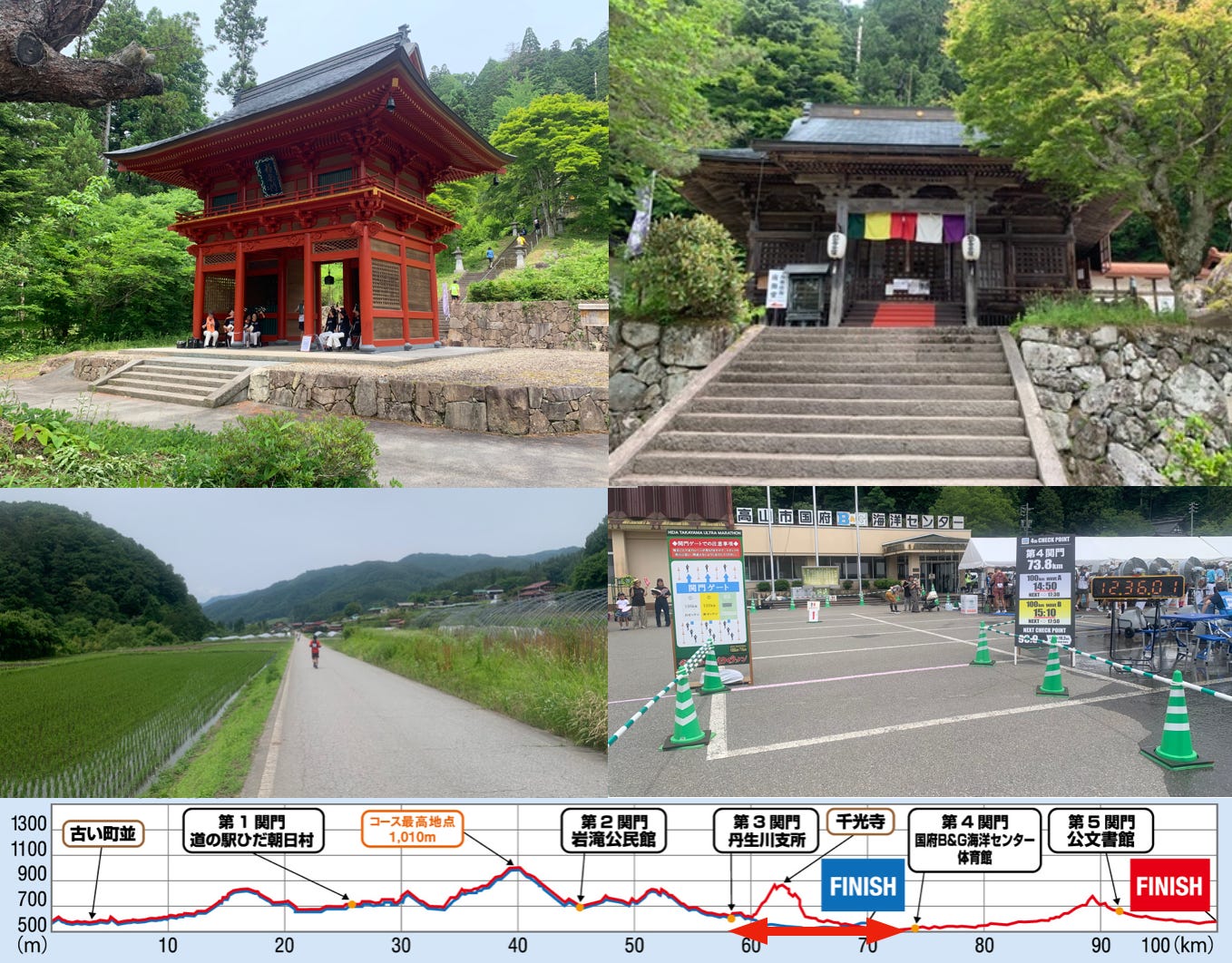
I arrived at this checkpoint at 12:36, meaning I was about 2 hours 15 mins ahead of the closing time of this checkpoint. Making good time.
Checkpoint 4 to Checkpoint 5 (73.8 – 93.0 km)
公文書館 : Archives Building
This section was starting to get kind of rough for me. I remember standing for a few minutes in a cold spray fan trying to cool off, but the fact that I hadn’t been eating properly and was only rehydrating and getting my energy from cola was clearly starting to catch up on me.
I spent a bit of time recovering here, eating and drinking whatever I could keep down. One of the local boys offered me some apple juice made from local produce, telling me in English that it is, “VERY DELICIOUS!” The whole interaction put a smile on my face and gave me the energy to carry on.
But the section was tough. I was needing to do my run/walk strategy even on the flats. I would pick landmarks like electric poles, road signs, walls, etc and force myself to run between them before setting up another rest point in my head as I was running along. The whole thing was pretty mentally taxing but it kept me moving forwards.
I tried to keep my spirits up by talking to the volunteers at aid stations but that boost only lasted me for a few minutes every time I left an aid station.
The whole section was a steady incline up to the point when that incline became the “final boss” hill that I’d need to deal with before finishing the run.
There was an aid station at the foot of that hill that for some reason had an ANA theme. Some of the volunteers were dressed like cabin crew and were giving out the soup they serve on those flights. I couldn’t face it at this point and just stood in front of one of those spray fans until I went from overheated to pretty much shivering before I set off again.
I trudged up that brutal incline and then managed to get some speed going again on the way to the last checkpoint.
On the way to that checkpoint I passed the 90 km point, and on the approach to the checkpoint I saw some locals cheering and shouting “Only 10 km to go!” My watch was showing 98 km so I was pretty infuriated by this, but I just smiled and kept my frustration to myself.
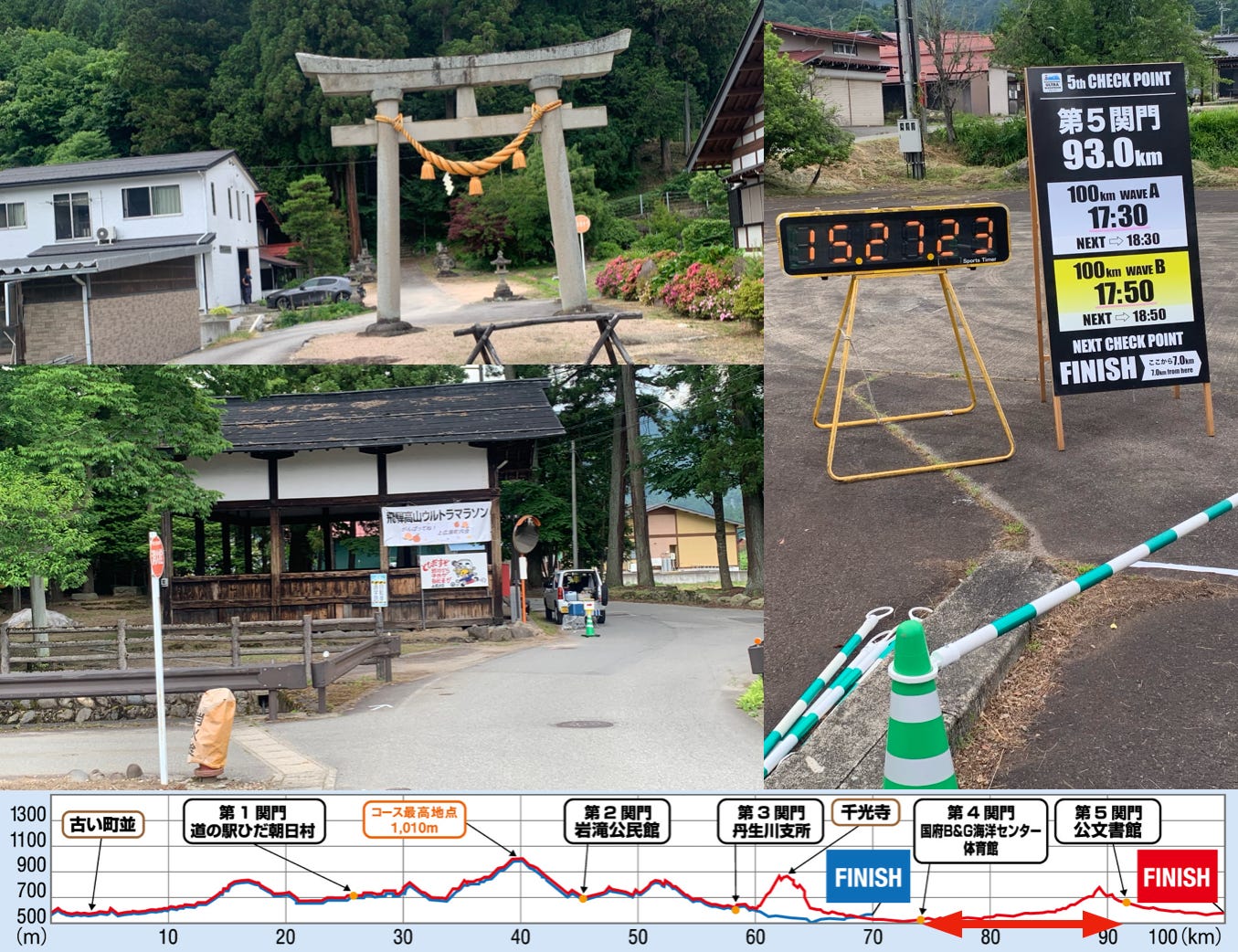
I arrived at this checkpoint at 15:27, meaning I was about 2 hours ahead of the closing time of this checkpoint. The pressure was on.
Checkpoint 6 to GOAL (93.0 – 100 km)
飛騨高山ビッグアリーナ: Hida Takayama Big Arena
I only had 7 km to go and didn’t want to change my strategy at that point. Cola, electrolytes, get moving.
This section was VERY difficult for me on a psychological level. I knew I had plenty of time to finish the race. I could walk the rest of the way at a slow pace and could still finish it comfortably. But since I had come so far with this time, I had a new personal best in my sights. I finished my last 100 km race (Nobeyama) in 12 hours 25 minutes. I wanted to not only beat that, but also finish this race in under 12 hours. To this end, I was quite unkind to myself.
Even the downhill sections of this part had me needing to take the occasional walk break. I don’t like wasting downhill sections, but I wasn’t exactly in a condition to keep hard charging. I would use the electric pole strategy again, but I was constantly looking at the ETA on my watch and cursing at myself every time I slowed down. It was showing that I would make it with my desired time, but every time I slowed I would get angry with myself.
During one walk break I tried to calm down and just keep pushing forward. Things started getting real when I started seeing signs counting down the final kilometers.
When I saw a 2 km left sign, I was pretty confident I’d make the cutoff. That gave me a bit more confidence and energy, so I kept the run/walk strategy going (with longer runs and shorter walks), until I hit the 1 km left sign, at which point I got more intense.
There was a small hill leading up to Hida Takayama Big Arena, and there were also a lot of people cheering, and other runners heading towards the finish line. This gave me motivation to keep going.
With the arena in sight I broke into a run. Not a jog. A run. I ran past people who were hobbling towards the finish line, past the people finishing the 70 km race, and up to the finish line.
The volunteers set up the finishing tape and I ran through it, knowing I had come in WAY before the time I set for myself and and stressed over for the past few hours.
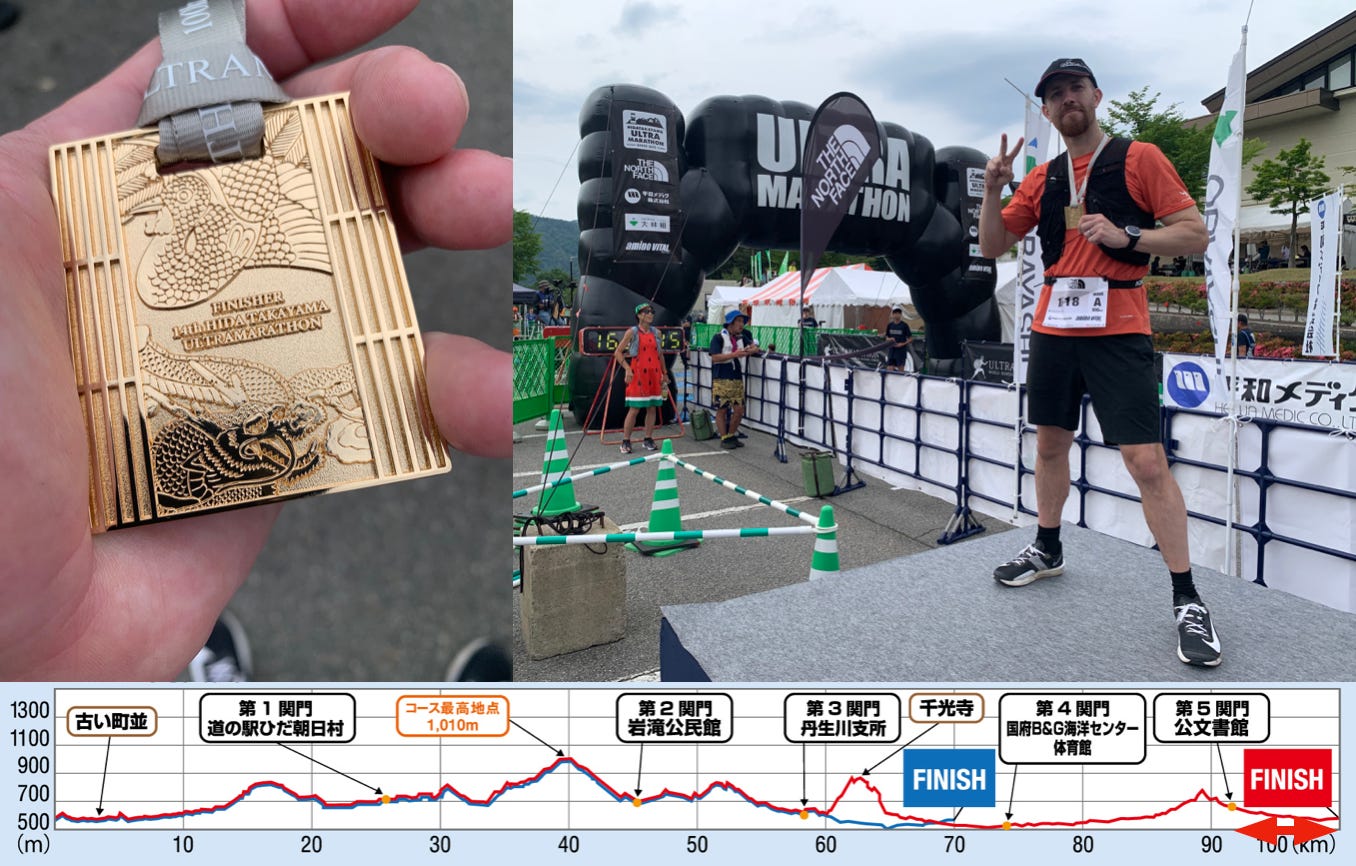
What a glorious feeling.
After the race
After running through the tape I stopped my watch and a volunteer put a medal around my neck. I then walked over to the finisher tent to get my tracking chips removed.
While I was sat down I heard a lot of commotion and a countdown. I had finished literally two minutes before the final cutoff time for the 70 km division. While sitting there I watched some people pass under the arch, and right after the countdown hit zero a guy crossed the finish of the 70 km race. I am not sure if he made it or not but if he missed it he literally missed it by a few seconds. I really hope he made it.
After getting the chip removed I went to get my picture taken near the finish line (as you can see in the photo above). I then tried to refuel a bit (though keeping food down was still a struggle).
By this point my right Achilles tendon had started seizing up and my walking gait was looking a little odd. I hobbled over to the shuttle bus area to be taken back to Takayama Station. When I noticed that all of the seats had been covered with plastic. The bus company obviously knew that there would be hordes of disgusting, sweaty ultrarunners that would be fouling their buses and prepared in advance.
I got taken back to Takayama station, went to a convenience store to get some supplies, then took a regular shuttle bus (not covered in plastic) back to my hotel (sorry). I was finally able to get some sandwiches into my system and went for a hot spring before settling down for the evening.
I stayed in Takayama that evening then took a steady journey back home the following day. I’m glad I stayed over rather than rushing back so I could enjoy another trip to the hot spring in the morning then have a low key day the next day.
Race Results
The final race results have not been announced yet. I will update this article when I have the data.
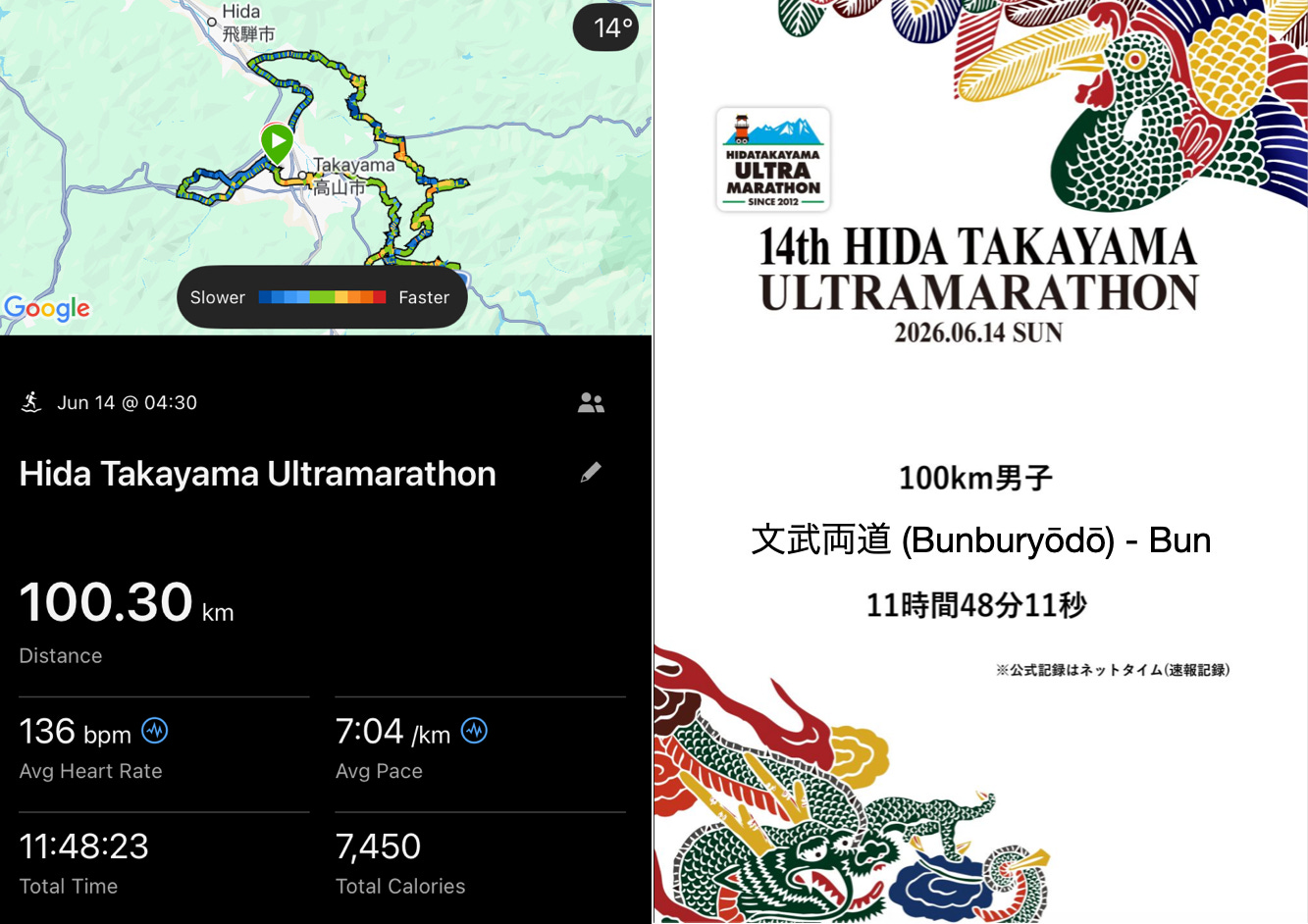
My watch time and the official race time were about the same. It took me just over 11 hours 48 minutes to finish the 100 km race.
This was my PB for a 100 km race, but looking back on my race data, it looks like it wasn’t an overall PB. I hit the 100 km point of the Challenge Fuji 5 Lakes Ultramarathon in 11 hours 42 minutes, meaning I missed it by a few minutes. But it should be noted that the terrain was very different at Fuji and the combined elevation was much lower. (My overall average pace was much better in this race).
Final Thoughts
This was my third race in this series.
Challenge Fuji 5 Lakes Ultramarathon (118 km, 973 m) : 14:37:54
Yasugatake Nobeyama Highland Ultramarathon (100 km, 2,300 m) : 12:25:30
Hida Takayama Ultramarathon (100 km, 1,643 m) : 11:48:11
Looking at the results, I gave my best performance at the Hida Takayama Ultramarathon. It was not an elite performance, but it was my best one so far.
In terms of elevation, the Challenge Fuji 5 Lakes is probably the most gentle in this series. It’s the longest, but it is definitely the one with the least punishing climbs.
Nobeyama had the most climbing in the ones I have done so far. What made Nobeyama difficult was the pacing. You needed to really put a lot of effort into the first climbs to be able to make the checkpoints. Then once you have spent a lot of energy you need to deal with an even bigger one later. The pacing was pretty rough.
Hida Takayama had less elevation than Nobeyama and was shorter than Fuji. This was probably why I got a better time. Upon reflection, I was probably the least prepared for this ultramarathon than I was with the others. I was unable to train as much as I would have liked to (hectic schedule leading up to the events), I went out a bit too fast during the start, and I probably didn’t eat enough over the runs.
So although it was my best result, I feel like I could have done better and as such, I will strive to be better in the future. Leaving an ultramarathon and thinking there is more to be done is a great way to keep the motivation going for the next one.
I am not sure when I’ll be able to attempt these but there are two more races in this series.
Nara Ultramarathon (100 km, 2,134 m)
Sanin Kaigan UNESCO Global Geopark Tango Ultramarathon (100 km, 2,300 m)
Nara is a new one and is VERY popular. It might be difficult to enter.
Tango is the one that looks like the most difficult of the bunch. It is set in September (it will be hot) and it is the one that is the furthest way from my place. This will make it probably the most challenging and probably one I should set as the “final boss” of the series.
Of course I’ll be setting myself other ultra challenges along the way. I really enjoyed the Fuji 100 Kai I ran earlier this year and will probably end up doing more trail ultras in the future. But I am 3/5 for this race series and would like to one day achieve this “grans slam” of getting all 5 under my belt.
Thank you
Thank you very much for reading. This was a long one. I hope that my experience with this race will be useful for people who want to take on the Hida Takayama Ultramarathon in the future.
If you enjoyed my writing please consider subscribing for more content like this.

🫡😎