
The Permanent Residency in Japan Discussion
Get it together

Background
If you have been on 𝕏 (the website formerly known as Twitter) over the past few days, you would know that there has been a bit of a kerfuffle in the expat community regarding proposed changes to permanent residency requirements.


To cut a long story short we probably need to take a look at the old requirements compared with the proposed changes.
But before we continue, there are a lot of heated discussions occurring online now. Note that the root of these discussions is not simply about permanent residency requirements. They are about whether we approach moving abroad as a short-term adventure or a long-term life decision.
Old requirements
Good conduct
Financial independence
10 years continuous residence in Japan
Including 5 years on a qualifying work/residence status
Payment of taxes, pension, and health insurance
Contribution to Japan’s national interest
Appropriate period of stay for current visa status
Some of these are a little vague…but none of them are particularly unreasonable. Live here 10 years, pay the taxes, pension, and health insurance you are legally required to pay, don’t break any laws, and contribute positively to Japanese society.
But what about the proposed changes?
Proposed changes / revised assessment criteria
Same as the old requirements. But…
Stricter assessment of financial independence
Greater scrutiny of income, assets, and ability to support dependents
Low income applicants may face more questions
Stricter assessment of tax and social insurance compliance
Late payments of taxes, pension, or health insurance are more likely to negatively affect applications
Greater focus on long-term stability
Immigration may consider employment stability, future livelihood, and overall financial situation more carefully
When it’s laid out like this, again, it doesn’t look unreasonable. However, one thing that has gotten a lot of people in a frenzy is:
Under the revised guidelines, an applicant will additionally be required to have an annual income in excess of the average for a Japanese household, as well as projected pension benefits equivalent to those the applicant would receive after 30 years of enrollment in an employees' pension program at that income level.
- July 26, 2026 (Mainichi Japan)
Let’s delve into this further:
Salary
According to the National Tax Agency, the average annual salary in Japan is 4.78 million yen. I am not a big fan of simply converting the currency because it only provides a snapshot and does not paint the full picture of the economic situations in those countries at the time, but to put this in perspective, ¥4.78 million per year is:
$29,220 (USD)
£21,879 (GBP)
For comparison, official statistics report median* full-time earnings of approximately £39,000 in the UK (7.8 million JPY) and approximately $62,600 in the US (9.4 million JPY). These figures are not directly comparable due to differences in methodology, working hours, taxation, and cost of living, but they provide useful context.
*Note: Japan’s figure is an average (mean), while the UK and US figures are median figures. They are not perfectly equivalent.
Pension
Some people are looking at this situation and are thinking that before they apply for permanent residency they need to have contributed into their pension for 30 years. This is not correct. It is not "you must have paid 30 years." It’s projected pension.
If Person A comes to Japan at 20 years old, pays into their pension for 10 years , then applies for permanent residency (PR) (30 at the time of application), they have approximately 35 years of potential future contributions before reaching the current pension eligibility age.
If Person B comes to Japan at 40 years old, pays into their pension for 10 years, then applies for PR (50 at the time of application), they have only 15 years left to contribute to their pension before reaching the current pension eligibility age.
Person A would have 10 years of contributions PLUS 35 years of future contributions. That gives a projected contribution history equivalent to approximately 45 years. Person B would have 10 years of contributions PLUS 15 years of future contributions. That gives a projected contribution history equivalent to approximately 25 years.
A realistic view of PR requirements
If I were to rewrite these in layman’s terms:
Good conduct (don’t break any laws)
Financial independence
Earn above the required income threshold (present financial independence)
Contribute enough to the pension system to cover your retirement (future financial independence)
Payment of taxes, pension, and health insurance
Contribution to Japan’s national interest
Appropriate period of stay for current visa status
And to put this in perspective, for the Japanese government to provide permanent residency to a foreigner who wants to live in their country, making sure they can take care of themselves now and also won’t create an avoidable risk of financial dependence on social systems in the future is a reasonable approach.
In response to this, I’m going to give a bit of practical advice:
Find out where you stand
Whenever there is an announcement like this some people have a knee-jerk reaction to start freaking out and acting like the world is coming to an end. They seem to post on social media first, then think about the situation later.
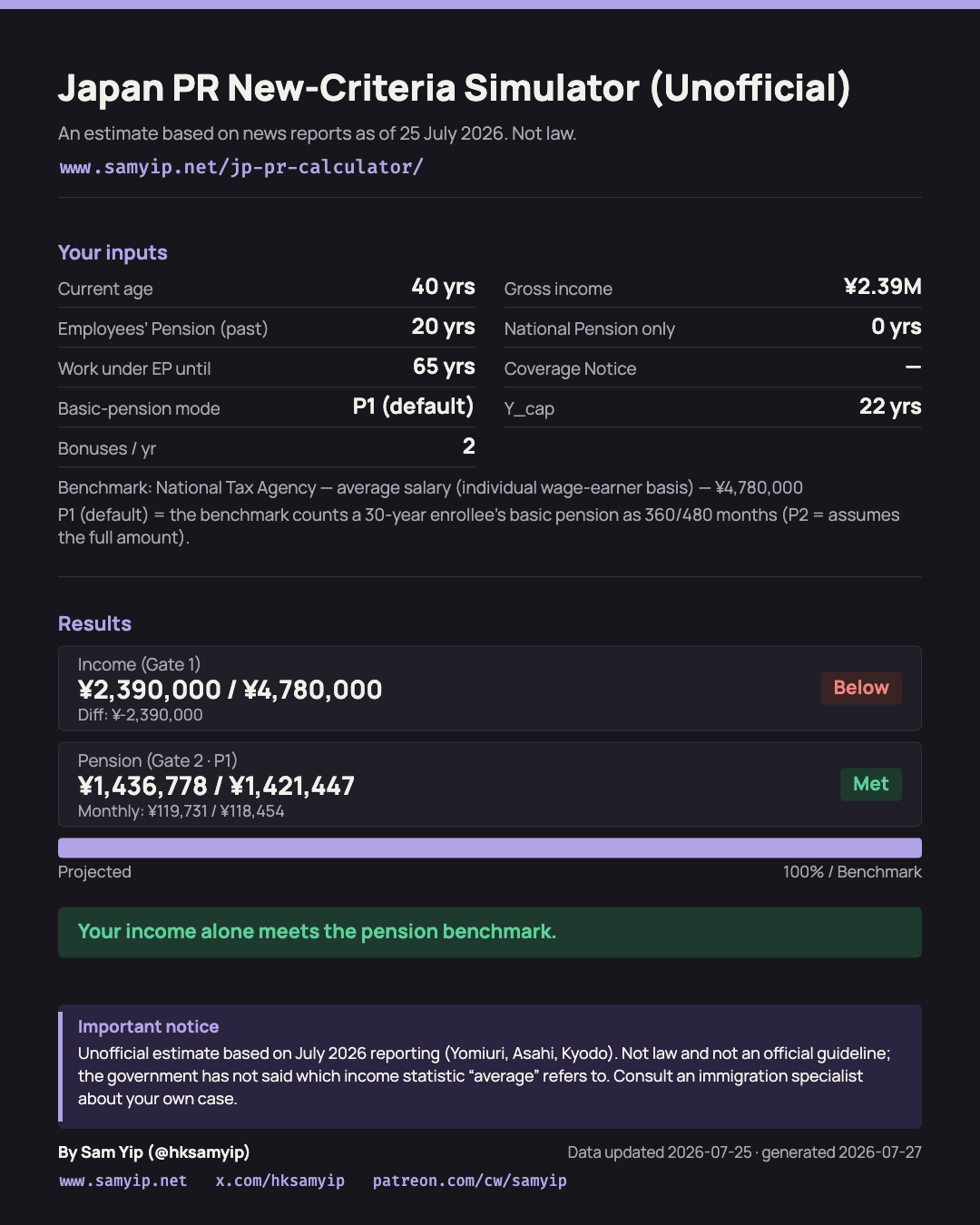
Very quickly after the new suggested requirements were announced, a calculator was put together to estimate someone’s eligibility for PR based on their salary, pension contributions, and age.
Before anyone freaks out about their eligibility, consider checking out this calculator. The 𝕏 post is below:


Once you have found out where you stand you have a roadmap of exactly what you need to do to qualify for PR. Many of the reactions I have seen online are hyper-focused on the “30-year pension contribution” and pay less attention to the income requirement.
Note that according to the calculator, a 40-year-old who has paid into their pension for 20 years while earning literally half of the median income in Japan still meets the pension requirement.
But what I am about to say next might annoy some people.
The reality of moving abroad
When I first moved to Japan I came across two different kinds of people:
Those who were on “working holidays”
Those who were serious about moving to Japan
If you are on a “working holiday” I can understand following your passions and just earning a bit of money while you have fun. But that is generally not a reliable way to build a long-term career.
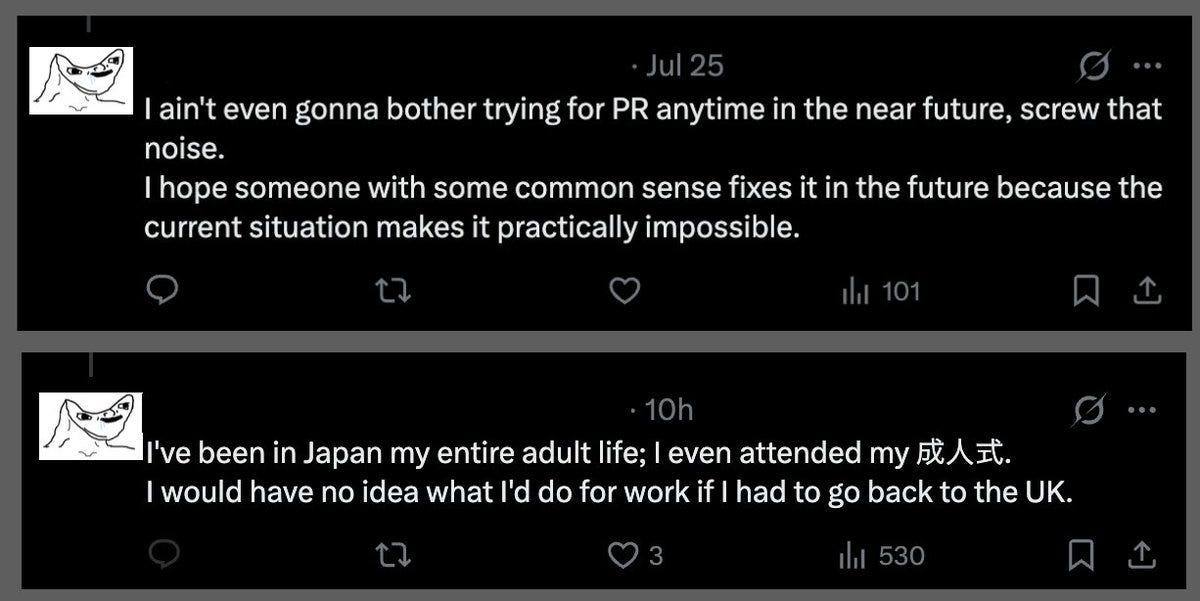
Over the past few days on 𝕏, I have observed people who came to Japan, found a job that sounded fun for a year or two, and then looked around TWENTY YEARS LATER realizing they were earning far less than the median salary. They delayed their PR application for 10 years and are now panicking that PR is “unattainable.” Of course, life circumstances vary. Some people prioritize lifestyle, family, location, or personal fulfillment over income. There is nothing wrong with that. However, those choices have consequences when applying for immigration statuses that assess financial stability.
On the other hand, people who are serious about moving to Japan focus on what life is going to be like further down the road. Speaking from personal experience, I knew what my maximum earning potential was in that job and I knew when my contract would end. So I did what I could to skill up, applied for a higher-paying job, then immediately switched over when my contract was up. When I found that that job wasn’t good for me, I applied for another job (with a salary increase included) and moved on.
Work while skilling up and apply for a better job enough and you will eventually find that you are no longer on an entry-level salary.
Now, I understand that everyone has different situations. But it’s a fact that some people come to Japan with a “working holiday” mindset and then spend decades earning an entry-level salary. And not only that, but they also sometimes appear unwilling to take the steps necessary to improve their situation. Someone who has been in Japan for 20 years and met the existing requirements could potentially have been eligible for PR for around 10 years (if they did everything they are supposed to do right in terms of tax, pension, and health insurance contributions). So why are they saying, “I’ve been here for 20 years and thanks to the new administration I’ll never get PR.” If it wasn’t important 10 years ago, why is it important now?
Final thoughts and Take Home Messages
For people who are thinking about moving to Japan (or anywhere else), this is my advice to you:
Think carefully about your future goals. If you want a working holiday, have fun, but if you want a career, think about how to make it happen.
Constantly think about how to improve your position. People who are entry-level get paid entry-level salaries. Work towards moving beyond entry-level positions.
Realize that obligations are obligatory. If it costs 200,000 yen to apply for something you need to save up 200,000 yen. Complaining about it isn’t going to make it cheaper.
Understand that as an expat, the country you are residing in doesn’t owe you anything. If you are struggling in your home country, you may have access to support systems because you are a citizen. When you move to another country, however, you cannot assume that country has the same obligations toward you.
Please consider these things BEFORE moving abroad. Uprooting your entire life and moving to a different country is hard work. Don’t mess it up.
Ultimately, this debate is not only about permanent residency. It is about a broader question: when we choose to move to another country, are we thinking about the next year, or the next thirty years?
Thank you for coming to my TED Talk.
Thank you very much for reading. If you enjoy my work please share it with someone you think would also enjoy it.
If you aren’t subscribed, please sign up to keep up to date.
If social media is more your thing I’m active on Facebook, and Instagram.
And if you are feeling generous but don’t want to commit to a monthly subscription, you can send a small donation to my Buy me a coffee page below.
