
The Cicada and the Mantis: Two Ways of Approaching Life
What insects can teach us about growing up, taking risks, and getting out of our comfort zones

Pokémon…in real life
As you may or may not be aware, Japan is a four season country. There are indeed four seasons in a lot of places, but each season in Japan feels like it’s a different world.
I won’t bore you with a description of each of the seasons (you all know what seasons are), but unless you have been to Japan in summer I don’t think you appreciate how ridiculous Japanese summer can be.
Summer in Japan is very hot and very humid. These are perfect conditions for massive insects and other creepy crawlies to thrive in. This is something I was definitely not ready for when I first moved to the country from the United Kingdom.
Bugs in the UK are a joke compared to the ones in Japan. The wasps in the UK can be pretty aggressive, but they are also much smaller than the giant hornets I see flying around here. UK insects are also much quieter. I sometimes cannot hear people I am talking to if I am in an area with a lot of cicadas (their chirping can sometimes sound like hundreds of people shaking maracas at the same time). Not only that, but there are also predatory bugs around like mantids and centipedes to keep the other bugs in check.
I have a bit of a love-hate relationship with the bugs in Japan. I don’t mind centipedes when they are outside, eating pests that might come into my place, but I don’t like it when they are in my place and I need to try and catch them with a pan lid and sheet of card so I can release them outside without hurting them. I also like the sound of cicadas, but I don’t like it when they fly around aimlessly and hit me in the throat when I am trying to cycle somewhere (true story, I nearly crashed my bike because of it). But I do generally get along with mantids.
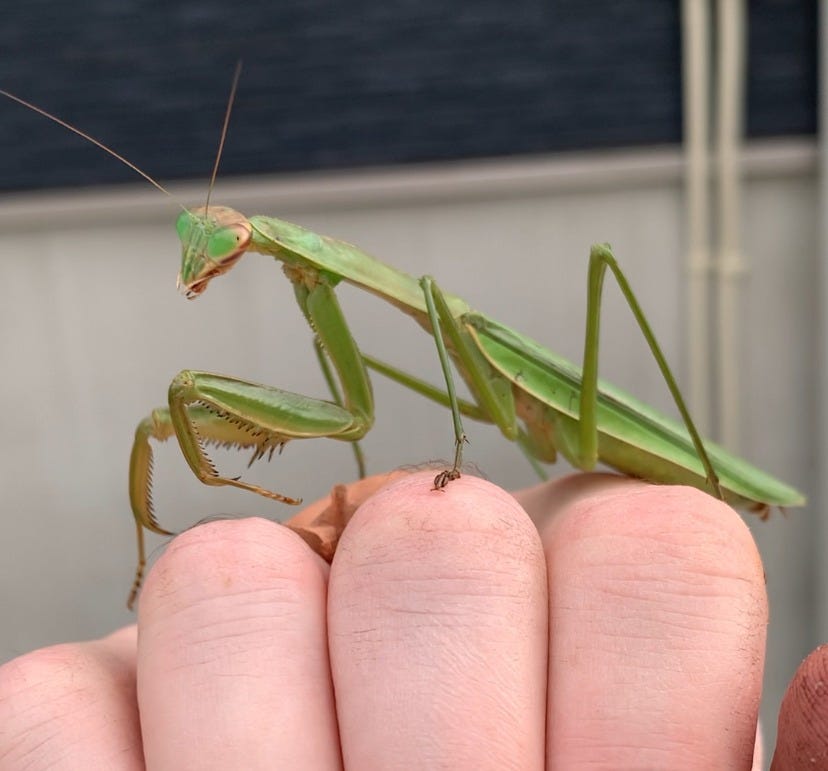
Some mantids will try to get away from you if you try to pick them up. Others don’t mind being held and act like little, carnivorous friends. But something that is interesting about mantids is that the nymphs (young mantids that are sometimes still quite large) cannot fly, but full adult side mantids can simply fly away whenever they feel like it.
Since it is summer and I am seeing (and hearing) a lot more bugs than usual, I decided to make today’s piece about what we can learn from them.
Life cycles
When I was growing up in the UK I remember learning about the life cycles of insects we see locally. Japan is no different. Kids in Japan learn about the life cycles of the insects they see around them, but the insects in Japan are much larger and easier to see.
While kids in the UK and Japan learn about things like an egg hatching into a caterpillar, which then turns into a chrysalis, which then becomes a butterfly, kids in Japan also learn about the life cycle of cicadas (which we don’t have in the UK).
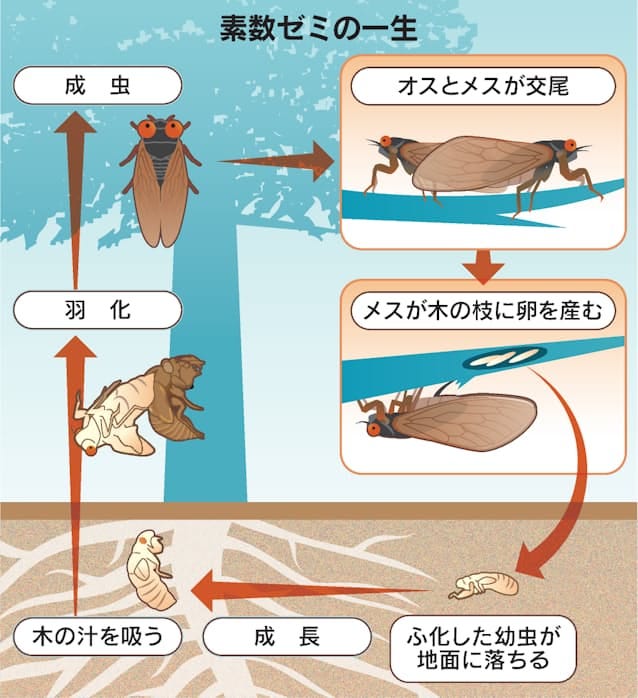
Cicadas are born from eggs which are laid on branches. Once hatched, the nymphs drop down to the soil then burrow underground. They then stay in the soil feeding on the sap from the roots for literally years (some species, such as the famous periodical cicadas of North America, can stay underground for 17 years. It should be noted however that cicadas in Japan don’t generally have 17 year cycles, I’ll use 17 years in this article). When it’s time, they then leave the soil, climb up the tree, shed their exoskeleton, then emerge as a winged adult where they will spend their days singing in the hope of finding a mate and create the next generation of cicadas.
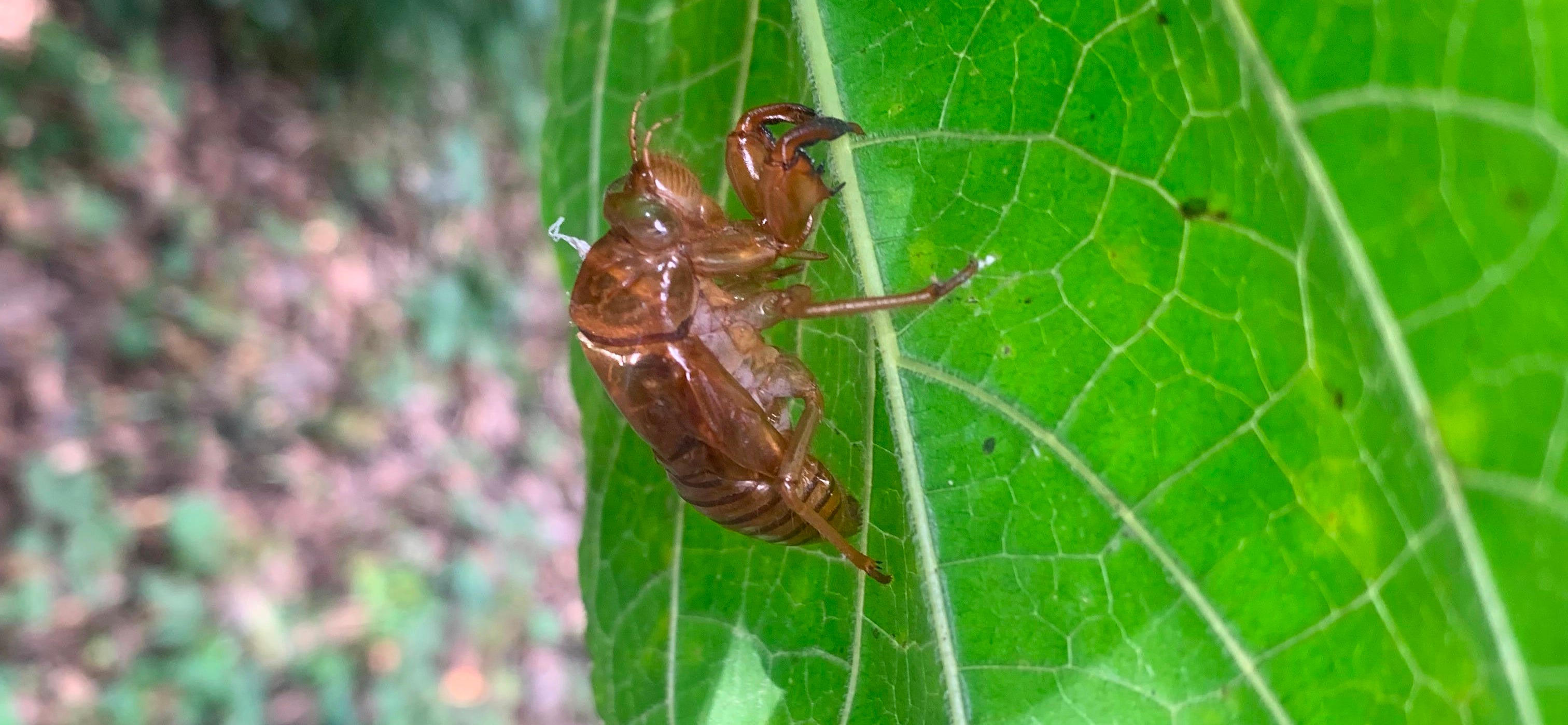
People who live in Japan will know that it is very easy to find 蝉の抜け殻 (semi no nukegara: cicada cast off shells) in the summer. Just for this article I went outside to find one and found this under a leaf of the first tree I came across.
I’m the kind of person that likes to ponder the deeper meaning of things sometimes. I consider these kinds of life cycles something we can learn from.
Mapping life cycles to humans
Whether we like it or not, humans are animals, and animals have life cycles. It’s not a one-to-one comparison, but there are things that we can consider when looking at the other creatures we share the planet with.
We have very little control over our lives when we are young children and are totally dependent on our parents/caregivers. Then when we grow up a little we get out there, explore the world around us, and over the years, grow up until we are ready to become independent adults. It’s at that point that we “spread our wings” and leave the nest as fully formed adults ready to do the duty that adults are supposed to do.
That whole cycle is very similar to the egg-nymph-adult cycle of a cicada. But an instinct driven creature like a cicada doesn’t have is a choice in the matter.
Safe among the roots
When cicadas are at their egg stage, they are probably at the most exposed they are ever going to be during their lives. Once they hatch into nymphs, they burrow underground and can spend years amongst the roots, “unbothered, mosturized, happy, in their lane, focused, and flourishing,” (as the meme goes). As I mentioned earlier, some cicadas spend 17 years living among the tree roots feeding on sap, but they pretty much don’t do anything else. They are pretty protected due to just living underground with a pretty much infinite (but poor quality) food source, but that is clearly not the way they are designed to live forever. Once they’ve spent enough time underground they crawl up the tree, molt for the final time, then “get a real job” as an adult cicada, where they will sing, mate, and die within a few weeks.
I’ve known quite a few people that live lives very similar to eternal cicada nymphs. They settle somewhere, get comfortable, then just never advance any further. But while a cicada can spend 17 years essentially, “living in in their parents’ basement,” before growing up and getting a job, humans can’t really do the same thing without consequence. Humans are not sap slurping cicada nymphs that can live underground for years. Like a mantis, they need to go out into the world.
草食系 (Herbivore) vs 肉食系 (Carnivore)
A few years ago this term 草食系男子 (sōshokukei danshi: herbivore men) became part of the public lexicon in Japan. It originally referred to men who are not interested in, “desires of the flesh,” aka, romantic relationships, but it has now taken on a broader meaning to refer to “passive men” who don’t have the drive to achieve and better themselves. The connotation is generally that they don’t have the kind of “go-getter” attitude that is needed in a society like Japan that is suffering from a low birth rate and needs people with a certain vigor to get things done.
肉食系 (Nikushokukei: carnivore) is the opposite of this herbivore attitude. Those who are seen as “carnivorous” are the active go-getters that are very much the opposite of the herbivores.
This kind of thing isn’t simply used to describe people and their attitudes. It can also be used to describe certain activities. I have heard people in karate circles describe certain styles as “herbivore” styles and “carnivore” styles. This sometimes comes in the form of traditional vs full contact styles, where traditional styles are more peaceful and generally react to trouble as it comes, whereas full contact styles spend a lot of time ramping up the aggression and training under quite aggressive conditions.
Put up your claws little mantis
Some people out there may want to live their lives like a passive, herbivorous, cicada nymph. They get in a comfortable little niche, then spend their years drinking the sap, and doing nothing but growing into older and older nymphs.
A mantis, on the other hand, hatches, then starts fighting its way up the food chain. They start off by eating very small insects like aphids, but as they get bigger they are able to eat larger prey, including things like grasshoppers. Some larger species may even get to the point they are able to catch and eat lizards and frogs that would have easily eaten newborn mantids.
When both cicada nymphs and mantis nymphs become fully grown adults, the “gift” they receive is to spread their wings and fly. This is how they fulfill their destiny to the best of their ability. (Note that a cicada that can’t fly is not an adult, but there are mantids that reach adulthood before they can fly. It’s just that male mantids that are able to fly are more likely to avoid getting their heads ripped off by their girlfriends).
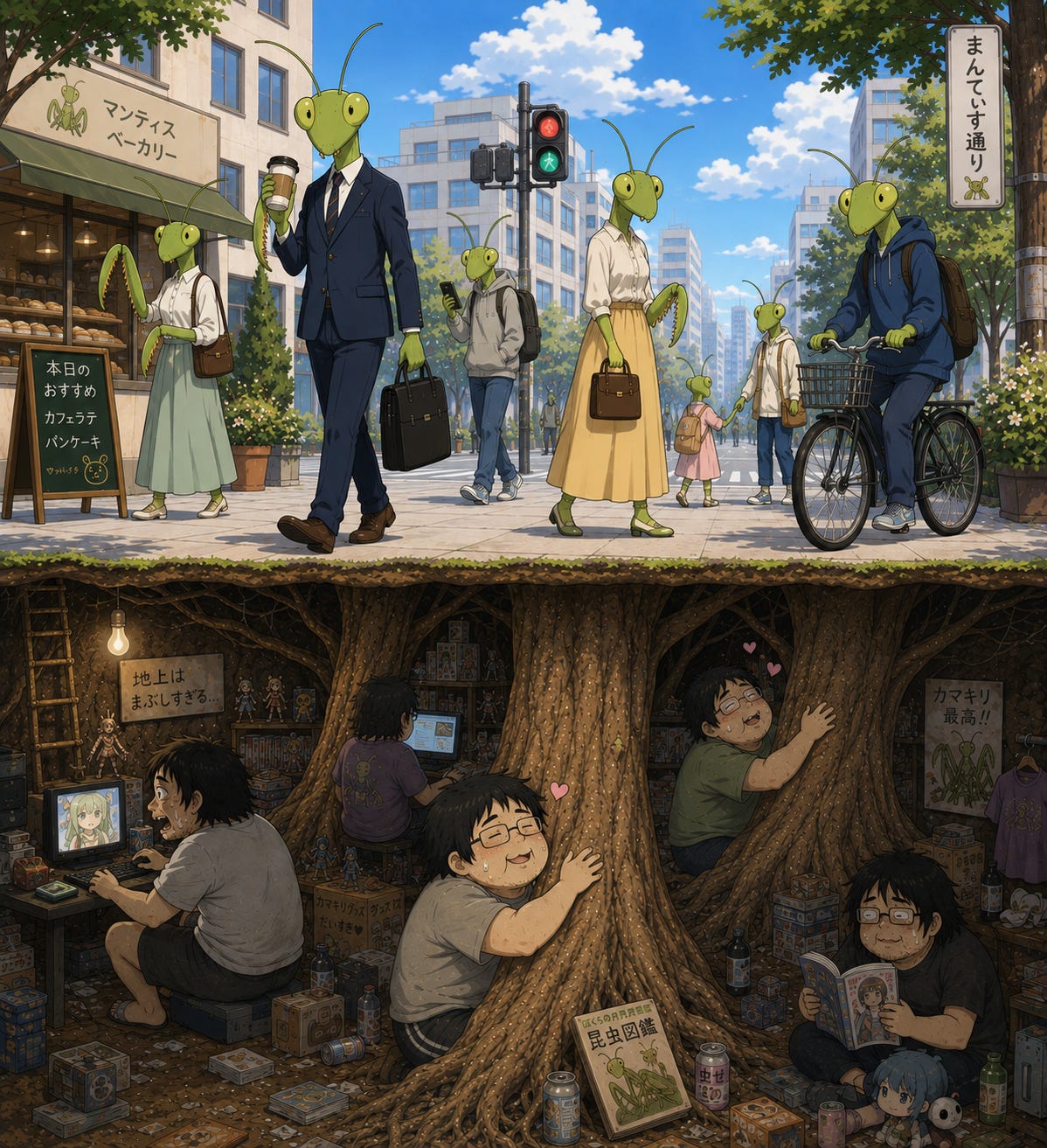
Humans are of course not the same as the insects we share our world with. Human society gives us a lot of choices and doesn’t punish us as instantly for our choices as the animal kingdom does. People can make the choice to curl up and hide away in their comfort zone like a cicada if they want. Life will catch up with them eventually. But those who accept that life requires you to get out there and fight your way up the food chain will generally do better in life.
Final thoughts and take-home messages
We can learn a lot about life by looking at the world around us. Even just the act of observing the life cycles of insects can be quite enlightening when considered deeply enough.
While the life cycles of insects don’t map exactly onto humans, it is clear that some people are acting more like herbivorous cicada than carnivorous mantids.
Whether you agree with it or not, fortune favors the bold. You can choose to spend decades living in a comfortable niche amongst the roots, but if you do you may never be able to grow up and spread your wings.
Get out there and stay hungry.
Thank you very much for reading. If you enjoy my work please share it with someone you think would also enjoy it.
If you aren’t subscribed, please sign up to keep up to date.
If social media is more your thing I’m active on Facebook, and Instagram.
And if you are feeling generous but don’t want to commit to a monthly subscription, you can send a small donation to my Buy me a coffee page below.
