Magic paper vs competent leadership
Master your ego
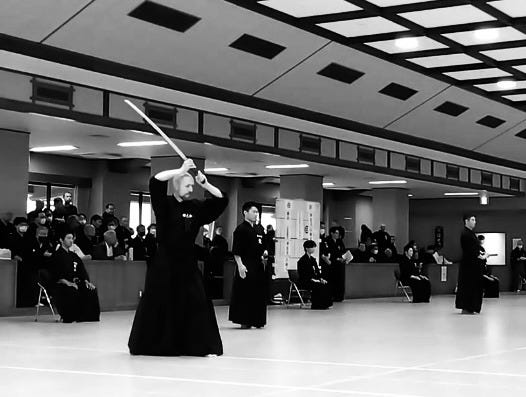
A few weeks ago I was taking part in an iaidō event when someone came up to me and asked if I was “Mr. Bunburyōdō.” Of course, I answered that I was and the gentleman that spoke to me said he reads my articles. What followed was a very pleasant afternoon of talking about life and martial arts. This article was inspired by that conversation.
Conditioning towards credentialism
I think I would be accurate in saying that pretty much everyone who is reading my blog has gone through the education system. From an early age we are put into systems where we have to study in order to pass tests with the end goal of graduating from that particular school.
Each country has its own way of describing the process but fundamentally, we all recognize that graduating high school and the qualifications associated with it is a pretty major milestone in education. It’s not a particularly high level qualification, but there is certainly a stigma associated with people who “dropped out of high school” and as such, those who have graduated high school are put on a pedestal above those who have not graduated high school. This is the reality whether we like it or not.
While attitudes may be changing now, “get a degree” was pretty much pushed universally when I was at school. It didn’t seem to matter what the degree was in, it was just that, “for now, get a degree", was what more or less everyone was told.
Once higher education comes into the mix we have another ranking system with high school drop outs at the bottom being labeled as ‘least educated,’ who are then followed by people with increasing levels of education in the order of high school graduates, bachelors degree holders, masters degree holders, then doctors of philosophy (PhDs). Whether we like it or not, this is the way people are viewed when we look at them through the lens of education.
However, I’m going to go out on a limb here and guess that many of my readers have spoken to some high school dropouts who are incredibly smart and some PhDs who are somehow totally inept at everything.
There’s no such thing as magic paper
James Randi was a magician that was famous for investigating pseudoscientific claims and paranormal phenomenon. He once gave an amusing speech where he talked about PhDs, and his theory that someone doesn’t become a PhD until they receive the diploma during their graduation ceremony. Up until that point they are not PhDs, but the second they touch the diploma, a chemical is absorbed through their skin that goes directly to the brain and shuts down their ability to say two phrases:
“I don’t know.”
“I was wrong.”
And it’s only at that point that they become a creature known as a PhD.
That clip can be found below:
If you have a PhD then you are at pretty much at the highest point that you can get to in terms of your education. There are of course add ons and people with multiple doctorates, but a doctorate is generally seen as the highest degree you can attain. Some people are able to cope with this very well and acknowledge that they know a lot about a specific field while not knowing everything, but other people cope less well with it and demand to have their credential respected (especially by people who have not reached that educational ‘rank’). (Weirdly enough, it tends to be people who are in very technical fields that cope well with it and people who are in more frivolous disciplines that demand special treatment).
Up to this point I have written specifically about the education system, but this kind of ranking system is also very present in martial arts as well. I previously wrote about my thoughts on ranks in martial arts in this article, but I would like to expand upon it further today.
As I stated previously, a martial arts rank shows your position in a system. And while it can be a reflection of the ability of a martial arts practitioner (you would hope that a 5th dan is more competent than a 1st dan), it is not an objective measurement.
I have previously (and perhaps somewhat cynically) said that martial arts ranks can be a measure of time served, payments made, and minimum standards met within a system. But in addition to that (and a it was pointed out to me recently) there is also the fact that ranks are sometimes given out based on someone having a good performance on one day. You might have someone who generally performs well do badly during a test and fail, while someone who generally performs poorly somehow do well on a test and pass. This can create a system where you end up with quite large differences in ability within the ranks, where some people end up slipping through and end up outranking people who are actually more competent than they are.
Sometimes the system can end up correcting itself over time (depending on the environment), but there can also be cases where some people who don’t cope well with having a high rank will have the attitude of “I outrank you so I’m correct,” or even lead to other people thinking, “That 5th dan outranks that 4th dan so they must be correct.”…even if they aren’t.
A certificate of rank or a diploma is not a magic piece of paper that makes someone always correct. Mature people will know that…but not everyone is mature.
Heavy (should be) the head that wears the crown
In my time I have seen people who get certain ranks and become very arrogant. Normally these are the kinds of people that see rank as a ladder to climb and see people on lower rungs as beneath them and as such, subservient to them. Most of these people tend to be involved with systems where there is little to no pressure testing and as such won’t get their attitude corrected through ‘physical education.’
To me, being a black belt can be risky business. One of the reasons I say that is because in my current system (a full contact karate system), the second you put on a black belt is the second that no one will go easy on you anymore. All grades below black belt are seen as preparation, and once you get to black belt you are a true practitioner and should be able to handle yourself. “Everyone wants to be a black belt until it’s time to start doing black belt things…like suddenly having full power techniques thrown at you by everyone.” But that’s just speaking about my experience in that full contact syetem.
Some martial arts styles are quite theoretical in nature. Others are more practical. When it comes to Japanese swordsmanship, iaidō is practiced in a very theoretical way, whereas kendō is very practical. Iaidō by its nature is about executing correct techniques in line with the way they were traditionally done in that style, whereas kendō has you training techniques that will be used in matches where you need to land techniques while also defending yourself. If you consistently get hit and don’t hit your opponent in kendō you are not doing kendō competently and won’t advance.
I am not a kendō practitioner so I cannot really talk about the injury levels, but I will hazard a guess that you are more likely to be injured being struck with a shinai than you are practicing iaidō forms. Practical arts tend to carry more risk than theoretical forms and as such, being wrong in a theoretical form is far less costly than it is in a practical form.
In the past (especially when I lived in the UK) I witnessed “high level karate practitioners” almost hide behind their rank. They did very theoretical forms of karate where striking an opponent was seen as “not being in control” of a technique. But of course, they were allowed to strike people of lower rank than them because they were simply demonstrating how well a technique could work. It was a very “rules for thee but not for me” kind of situation. However, in 実戦空手 (jissen karate: practical karate), in all of the forms I’ve practiced it, senior ranks have no problem handling junior ranks going full power at them. They can guard themselves using the practical skills they’ve learned and strike back in a controlled way when needed.*
*One of my 後輩 (kōhai: junior(s)) is entering a tournament this year. Last week I just had him attack me full power to try to keep his stamina going. I just blocked and dodged his strikes but occasionally planted a controlled strike on him if he was leaving himself too open. This is how seniors should be able to handle junior grades in my opinion.
I’m not really sure how it has gotten to this point but some people treat senior ranks as if they have earned a place in some kind of nobility or aristocracy. They seem to forget that having experience and the rank that comes with it also comes with responsibilities.
Master AND Apprentice
I’ve previously written an article about the term 先生 (sensei) and the fact that it literally means someone who has lived before you. You look up to them because they have been walking the path for longer than you have and as such are able to offer guidance on how you can improve in that field. But sensei is an honorific term and isn’t used in the same way as it is used in English.
When you are speaking English, “He is my instructor,” is a reasonable and understandable sentence. It is reasonable and understandable to say, “He is my Sensei,” when speaking English, but that is using Sensei as a loan word. In Japanese it’s less technically correct to refer to a martial arts instructor as your ‘sensei’ and you might be more inclined to use something like 師匠 (Shishō: teacher/master). But personally, I do not like the term ‘master’ in English because it is often misunderstood.
The term ‘master’ is often associated with someone who is in charge, has authority that cannot be questioned, and has people beneath them that are totally subservient. But that does not describe a ‘master’ in a martial arts context.
When we look at apprenticeship systems, we have people who are “master craftsmen” who will take on “apprentices” in order to train them up to the point that they can become professionals (journeymen) in their field. This is the context in which martial arts instructors and martial arts students are supposed to operate. Your “Sensei” (as many people would refer to them) is the person responsible for your education in that martial art. It’s their responsibility to pass down the skills and practical knowledge that their students (apprentices) need to eventually go off on their own and make it in the real world.
And while this post very much focuses on martial arts, it’s actually applicable in most fields. If you have a PhD you are a doctor. The term ‘doctor’ comes from the Latin docēre, which means ‘to teach.’ You are not elevated to nobility by getting a doctorate. You are elevated to a position of responsibility to the people you may be teaching. It’s not simply being put on a pedestal above others. Receiving a magic piece of paper (or a rank) isn’t a mark of you being a better class of individual than others. It’s a mark that you have achieved something and are now equipped to help others on their journey to do the same.
Final thoughts and take home messages
Credentials can be a great way to figure out if someone is good at something or not. If I have a problem and need surgery, I’d rather be operated on by a qualified surgeon than someone who has watched a few YouTube videos on the subject. But credentials are not the be all and end all. There are some very qualified people out there with no practical ability and some people with no qualifications who are brilliant.
Receiving a qualification or rank does not suddenly make you correct all the time. There’s no such thing as magic paper.
If you have a qualification or rank you should ideally live up to that rank and be able to walk the walk and not just talk the talk. There’s an expectation that comes with ranks and qualifications. Unfortunately some people slip through the cracks with this. Especially if they operate in theoretical systems.
And finally, I would really like it if people started thinking about martial arts ‘masters’ in the contexts of ‘master craftsmen’ rather than group leaders that can’t be questioned. A master’s apprentice will of course ask their master questions all the time in order to prepare themselves to go off and achieve great things in the world themselves. Any master who is not willing to be questioned like that either doesn’t deserve or doesn’t understand the title.
Thank you very much for reading. If you enjoy my work please share it with someone you think would also enjoy it.
If you aren’t subscribed, please sign up to keep up to date.
If social media is more your thing I’m active on Facebook, Twitter, and Instagram.
And if you are feeling generous but don’t want to commit to a monthly subscription, you can send a small donation to my Buy me a coffee page below.
Osu!


