
Fuji 100: Kai 70K
Race report 23: First world trail major

I’m quite fond of trail running. I do a lot more road races than I do trail races, but every time I do a trail race I always feel a deep connection to the experience.
Probably the most famous trail race in Japan is the Fuji 100. This is basically the Japan equivalent of the Ultra Trail Mont Blanc (UTMB).
Getting into these races requires you to qualify by completing races associated with the International Trail Running Association (ITRA). When I ran the Izu Trail Journey in 2024 I gained enough points to be eligible to enter the Fuji 100 Kai 70K. So I put in an entry Autumn of 2025, got selected in the lottery and was given a place for the 2026 event. This report is about that race.
The course
Over the course of this report I’m going to be directly quoting from the Course concept. That will appear as quotes.
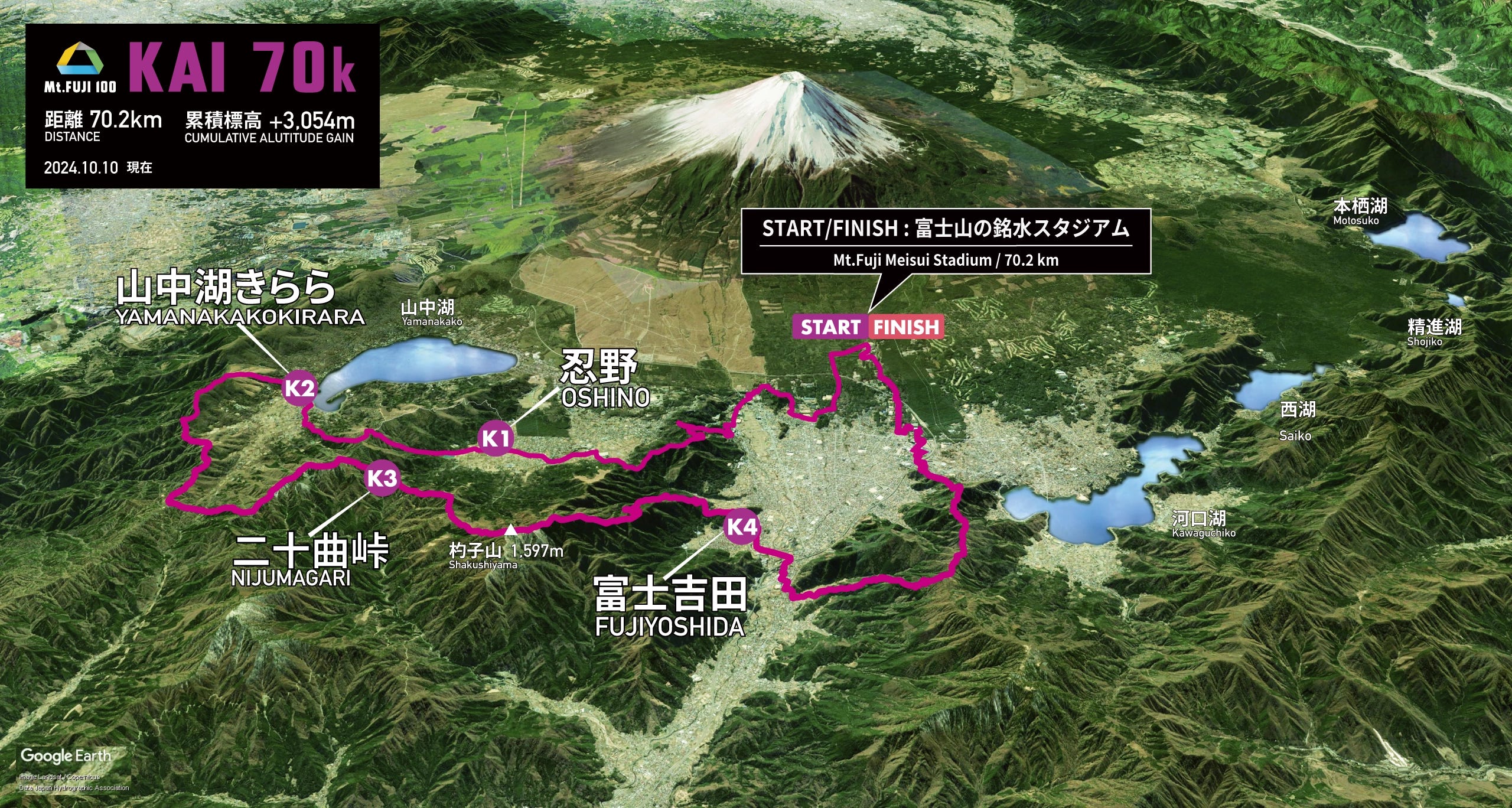
The KAI 70k course, which has been held since 2022, is the latter 70km section of the FUJI 100mi. The entire course is within Yamanashi Prefecture, and the name "KAI" is derived from "Kai no Kuni," the former name of Yamanashi Prefecture.
Below is a map of the regular route of the Kai 70K.
And here is the elevation plot.
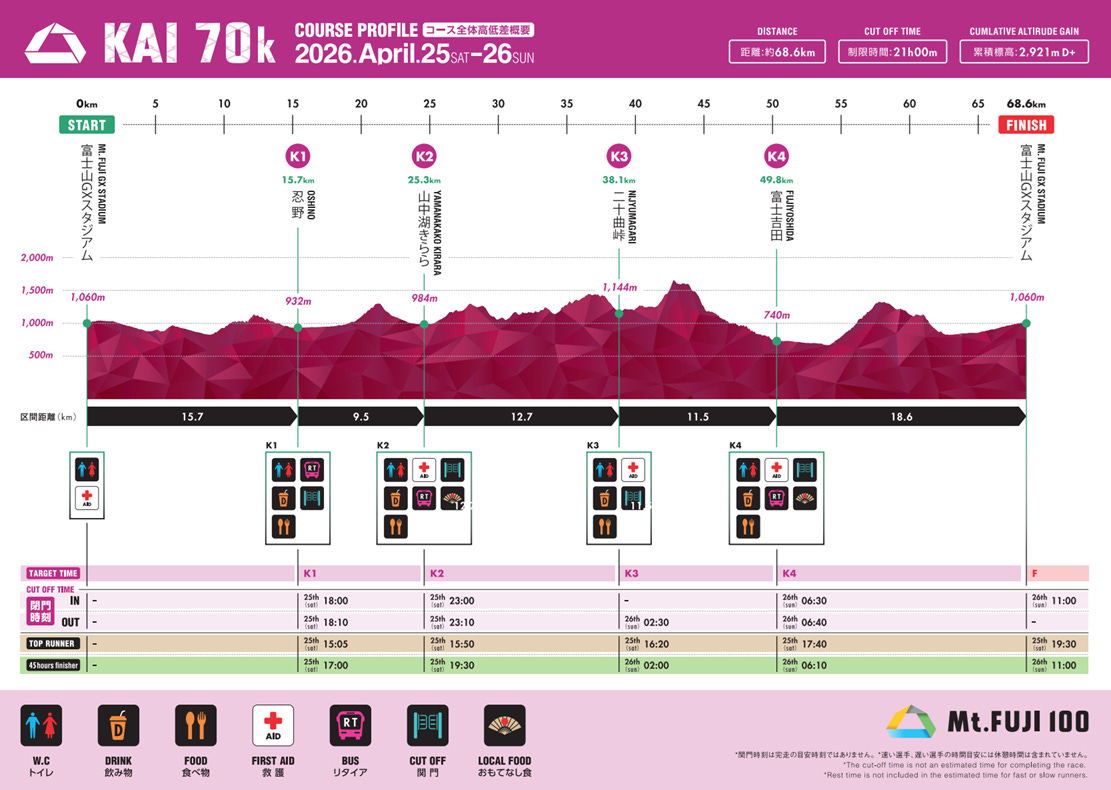
The Kai starts at 14:00. That means I’ll have roughly 4 hours of daylight before I’ll be running in the dark.
The race has a generous cut off time (21 hours), which means you need to keep a pace of 18 mins 22 seconds per kilometer. I usually walk much quicker than that so I thought it wouldn't be a problem to (at the very least) finish, but such generous timing takes into account the rugged terrain and climbing sections.
Race day
I arrived in the 山中湖 (Yamanakako) area a day before the race started. Arriving early for a race that starts in the afternoon is a bit of a double edged sword. I spent the morning kind of anxious and ready to go, and was eventually dropped off about three hours before the race started.
I walked through the expo, picked up my race number, dropped off my bag, then ran into some friends of mine. They had already been supporting some of the other racers in the 100 mile division but one of them was also running the Kai.
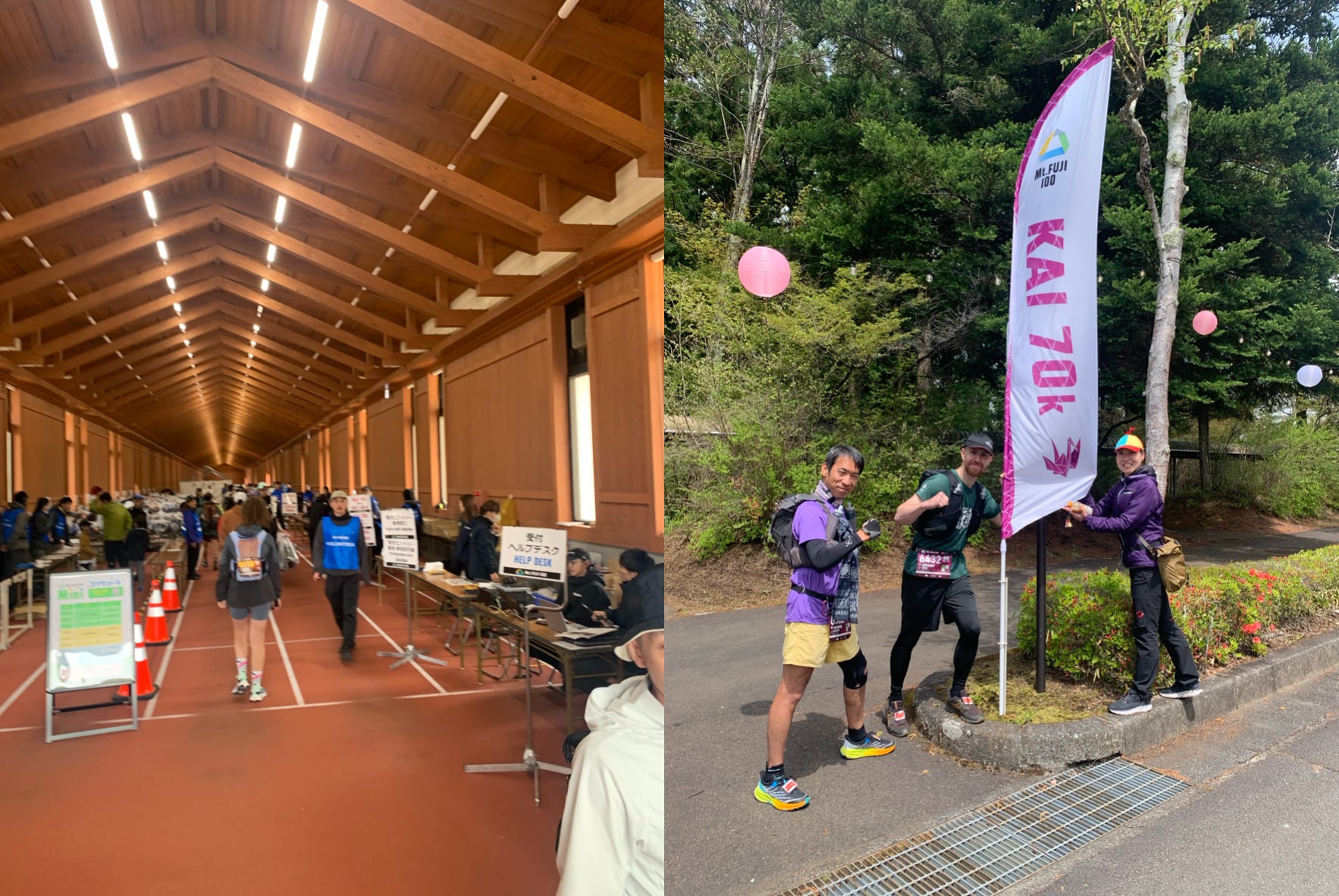
We watched the start of the new Asumi 40K race, got some food, and then went to the starting area for some final preparations. At this point I asked a staff member if there was a place I could fill my water bottles and he directed me to a tap and also advised me there was a vending machine in the next building too. I was kind of expecting an aid station style fueling point at the beginning for the runners, but that was fine.
The starting area ended up filling up quickly with runners and supporters holding a bunch of flags representing the international participants. People kept jumping in front of the starting gate to take pictures (myself included) and then we just needed to wait until the race started.
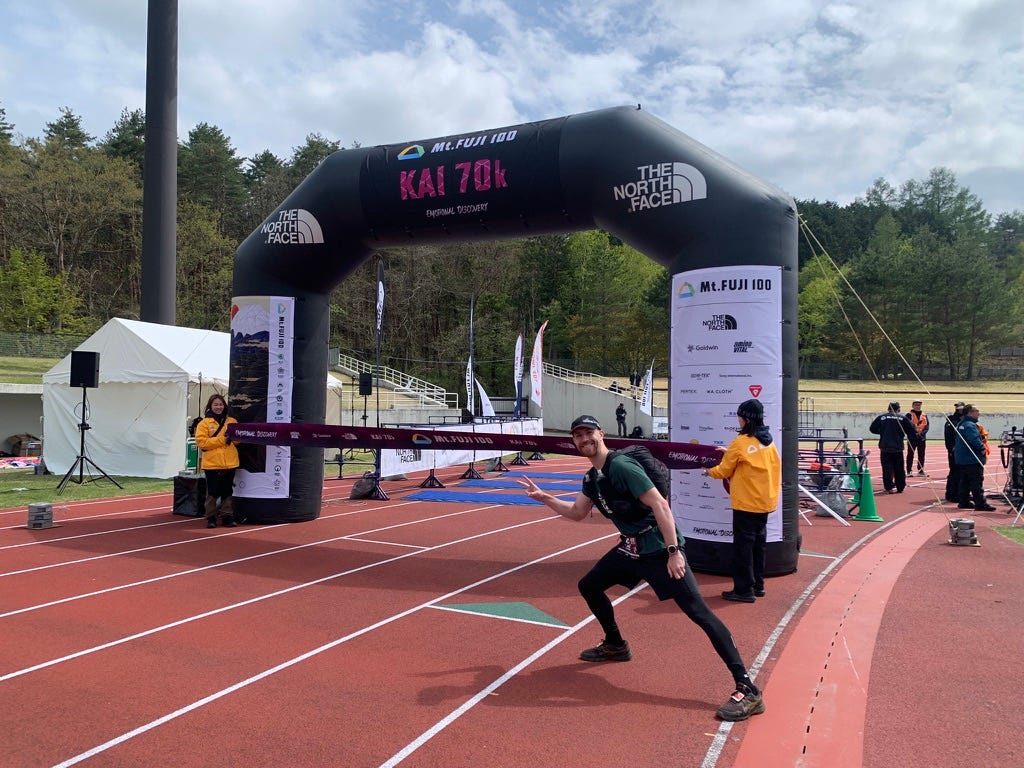
Just before things kicked off the race director got on stage, did a guitar solo, and then did a speech in both Japanese and English explaining the course concept. There was a real emphasis on, “this is going to be easy until after the second aid station.”
The video below shows the beginning of the Kai 70K. (For this Substack article I have downloaded videos from the Mt.Fuji100 official page on 𝕏).
富士山GXスタジアム (Fuji GX Stadium) to 忍野 (Oshino) (15.7 km)
The first half of the course is relatively peaceful, passing through urban areas, rural landscapes, and along streams.
The very beginning of the race was an uphill charge with all of the runners. Everyone was going through the entrance funnel and although it was a little tight it didn’t feel like a fight. Everyone just surged forward and moved at a good pace.
I had been dropped off before the race and we had driven up a VERY large hill on the way to the start. I mentioned that it was going to be a fun way to start the run and I was correct in my assessment.
I am quite good at running downhill on roads (more so than trails), so I spent the first few kilometers of the race hard charging down the big hills. While the majority of marathon runners tend to share similar thin, streamlined running builds, trail runners come in a lot of different shapes and sizes and some of the bigger runners were flying down this hill, letting gravity do most of the work.
There were a few uphill sections on the way to the very first trail, but I kept running along at a pretty decent clip with the whole pack until I hit the first real trail section. This is where I came across my first “traffic jam.” It was actually not much of a jam because I got directly onto the trail and everyone was moving at a comfortable pace. The trail itself slowed everyone down.
Note: I saw a friend of mine’s pictures after the race and it looked like if you didn’t hit that first trail you would end up in a REAL traffic jam, with people pretty much stood in a line on the road waiting to enter the trail. Glad I got there at a decent clip.
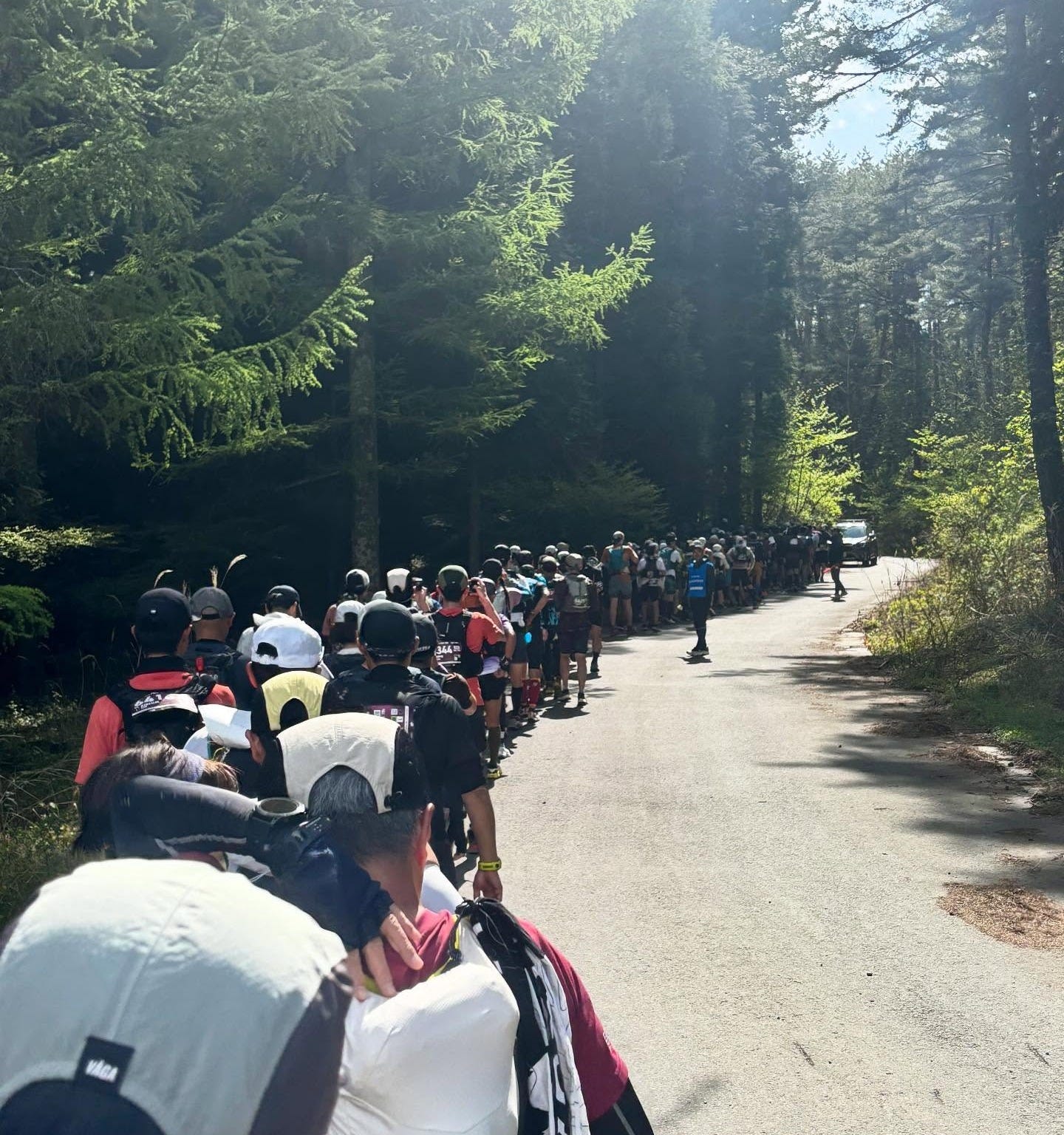
The first set of trails were very runnable. The forest was nice and was broken up with a bit of road running. The downhill section finished at about 9 km and then a bit of a slog up a mountain started.
At about the 11.5 km I entered an area that appeared to be a place where fruit trees were being cultivated on the side of a steep hill. The trees were all covered in nets. It was a bit of a bizarre site to see at first because I went from a deep forested area into a place where trees were spaced out and wearing hair nets. But as I progressed a little further and looked to the left I saw a fantastic view of Mt Fuji viewed from above Oshino. I stopped to take a few pictures on the way and then continued to climb a very steep slope for another kilometer before the next big descent.
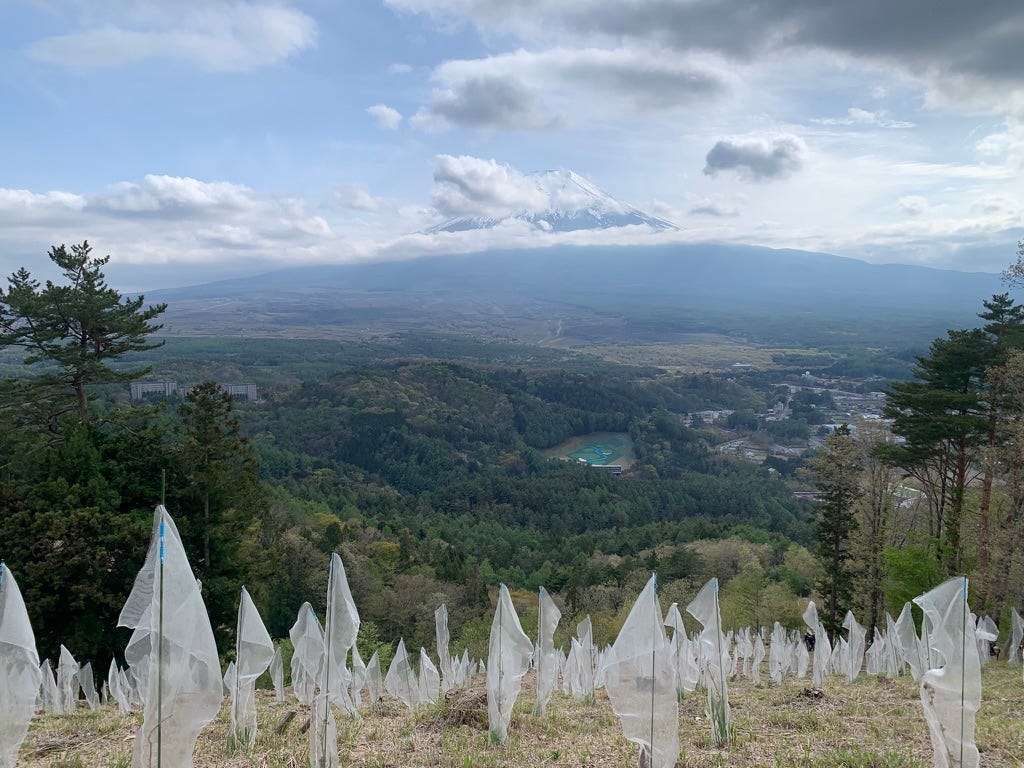
There was a big descent for the next 3 km, but again, at this point it felt very runnable. I comfortably breezed into the Oshino aid station at about 15:40, meaning I’d taken 1 hour and 40 minutes to cover the first 15.7 km. This gave me a lot of time to get to the next aid station.
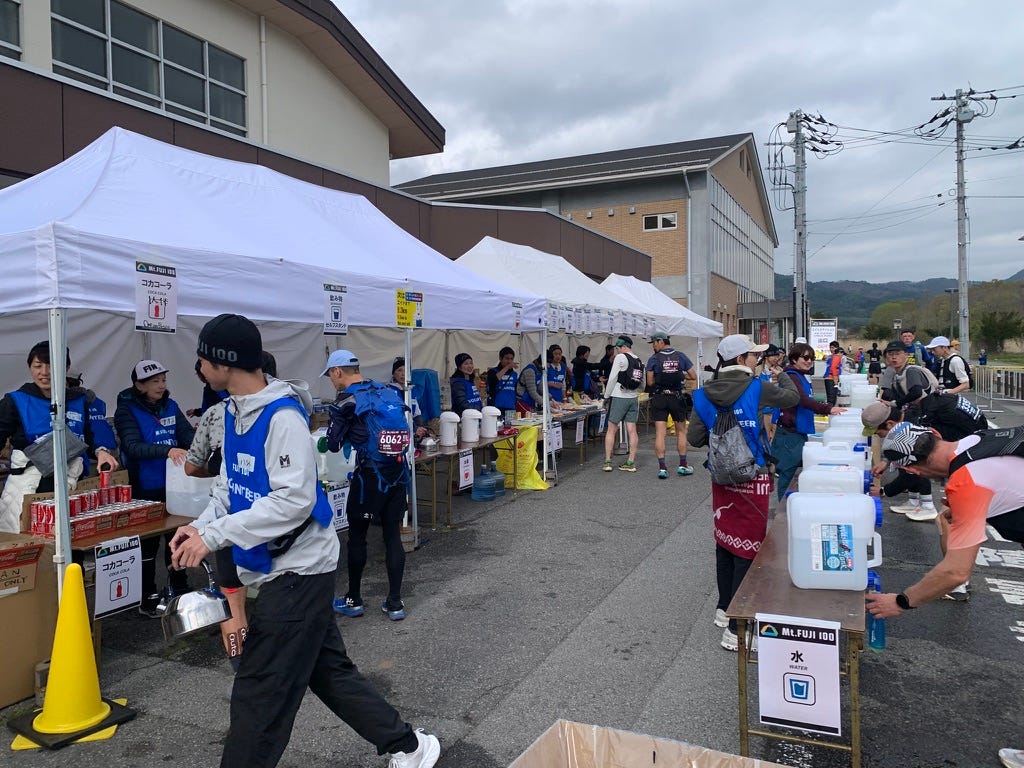
At this aid station I filled one of my water bottles with one of those Medalist sports drinks, ate a bunch of chocolate bread and bananas, drank a can of coke and then started towards the next aid station. My plan was to get to the next one before it got dark.
忍野 (Oshino) to 山中湖きらら (Yamanakako Kirara) (25.3 km)
The next section of the course started off pretty flat. After the decent I’d just done, a flat course felt a bit more challenging than it would have done under normal circumstances.
I knew I had a decent amount of time to get to the next aid station and thought it wouldn’t be in my best interest to hard charge this section, so I jogged along at my own pace for a while, walked if my heart rate started creeping up too high, then started jogging again.
I was jogging along a river and then through some farm areas until I eventually came to the next trail head. This section of the course led us up to 平尾山 (Mt. Hirao).
This part of the course started getting a bit more “wild” than I expected it to get.
There was a 200ish meter climb and we needed to go through some fenced off areas to keep the wildlife out. I might be misremembering the exact location of this (it might have been in the next section) but I was running along I saw the top half of a boar’s head just lying on the trail. I’m not sure how fresh it was and although I wish (in hindsight) that I’d stopped to take a picture of the grisly sight, my lizard brain told me to keep moving and I just sort of jumped out of the way making a disgusted sound while running into the woods. Another runner from Hong Kong asked me what the matter was. After telling him his reaction was to yell, “OH MY GOSH," and pick up the pace to get out of the area.
This section ended in a particularly long staircase like area with fewer and fewer trees until we got to the peak of the mountain.
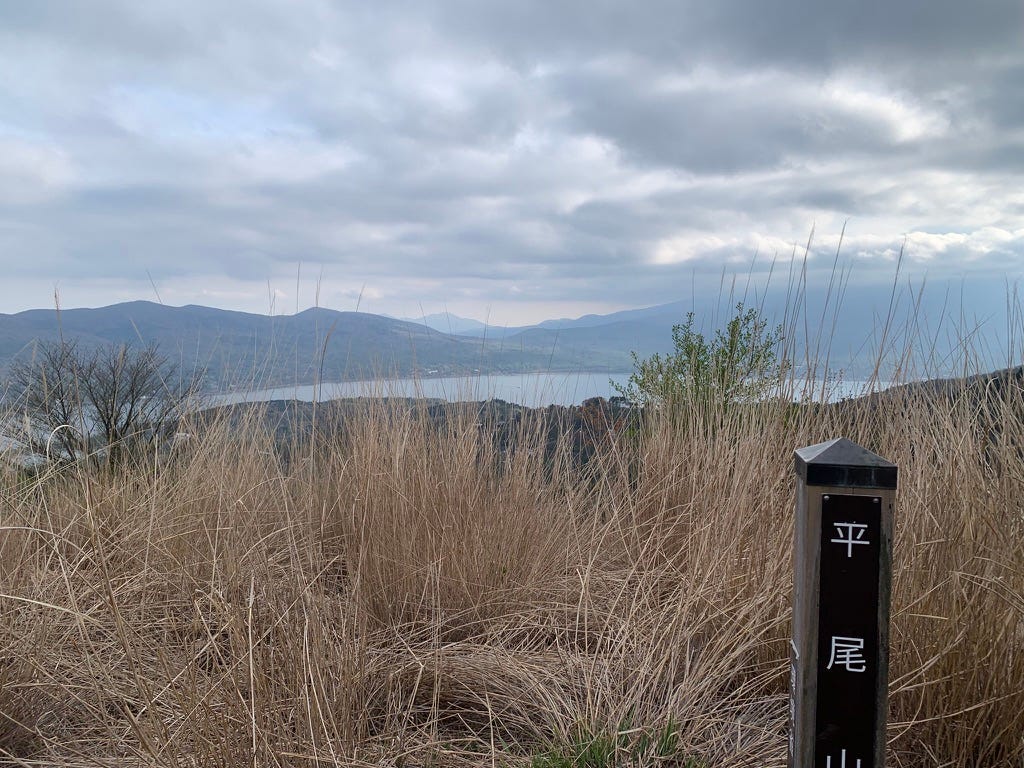
We then descended into the Yamanakako town area, through some residential areas and then along the edge of Lake Yamanakako until we reached the next aid station. This aid station was VERY welcome. Pork soup was the main thing on the menu at this aid station, but in addition to that I drank two cans of Red Bull, some more chocolate bread and some other snacks.
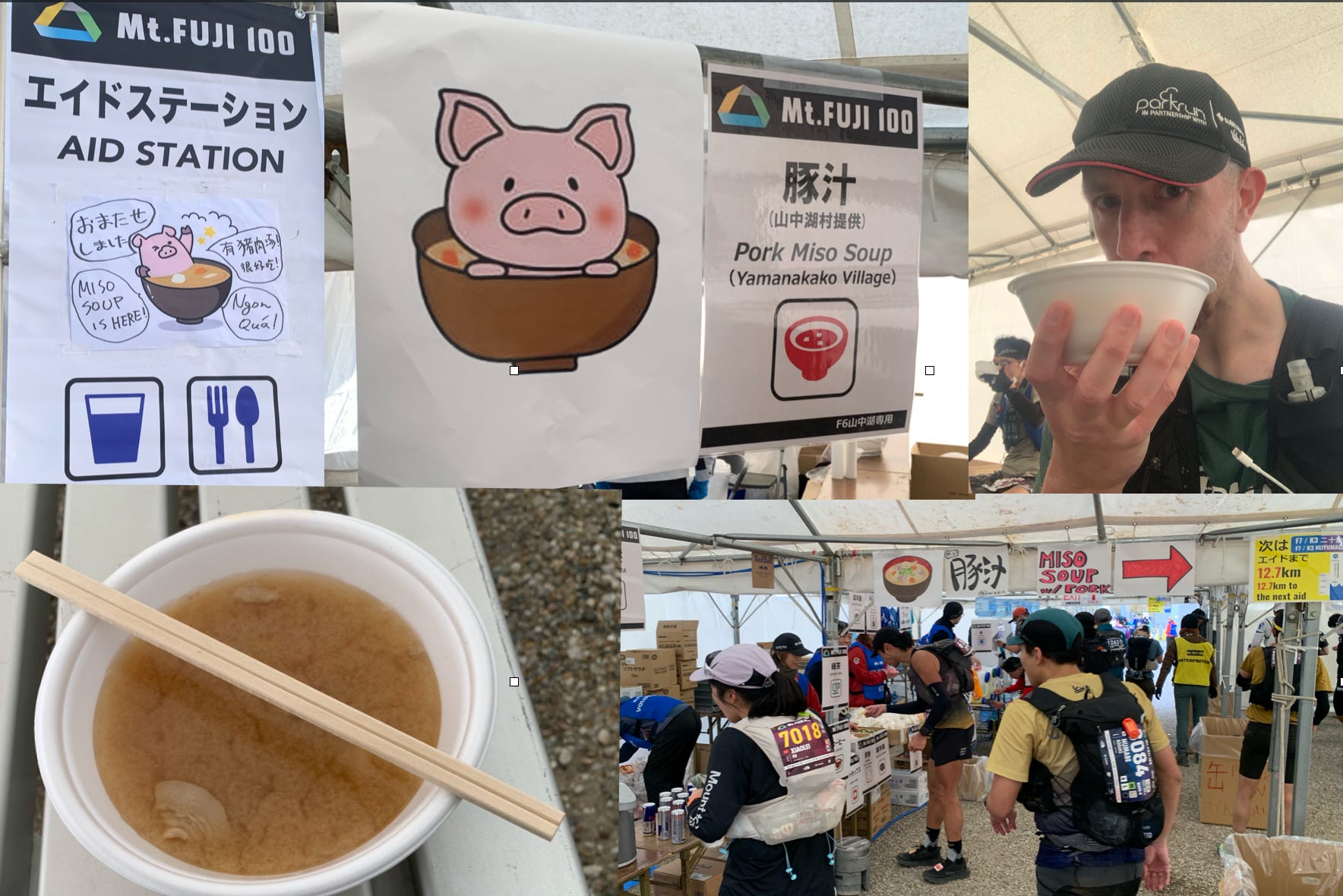
山中湖きらら (Yamanakako Kirara) to 二十曲峠 (Nijumagari) (38.1 km)
After passing the Yamanakako Kirara aid station at the 25km mark, a series of high, deep, and rugged mountains appear one after another: Mt. Myojin, Mt. Takasashi, Yamabushi Pass, Mt. Ishiwari, and Mt. Shakushi. Although these mountain ranges are rugged, they are protected by beautiful and lush primeval forests of Japan, and you can admire the majestic figure of Mt. Fuji from various points along the way.
The course concept delivered exactly what it promised.
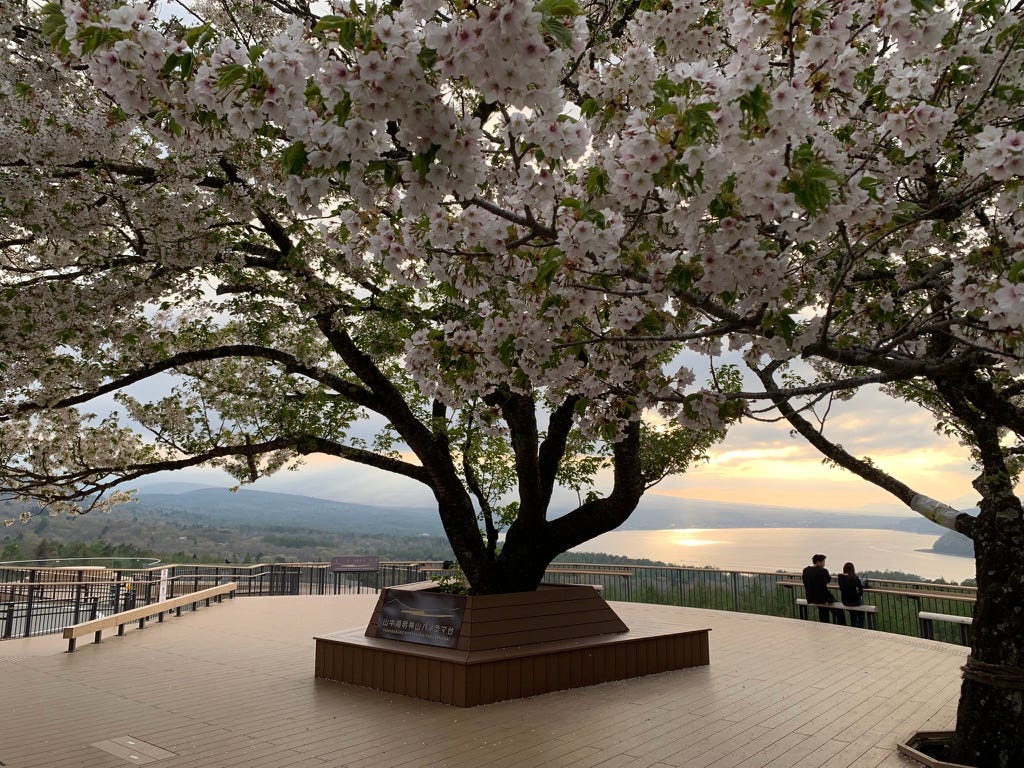
I left the aid station and pretty much immediately started going uphill. I was being led into an area of Yamanakano that I stayed at about a year ago. When I went by previously there was a viewing deck being constructed, but at the time of the race it had been finished. There was a cherry blossom tree blooming in the middle of the deck and I felt like it would be rude not to take a picture.
The next section was apparently called 鉄砲木の頭 (Teppōki no atama). It was a barren, hilly section on the way up to the peak of 明神山 (Mt Myōjin). I saw some volunteers flying a drone around the area and later found some of the drone footage online. The following video is from that section.
This climb was very hard going but I was very much in the groove of power hiking up these hills. I tend to do well walking quickly up hills of any kind so I made quite a lot of ground in this section. I got to the summit of the mountain and managed to get a picture of the sunset over Yamanakako. This was pretty good considering I was about almost 29 km into the course and was still operating in daylight.
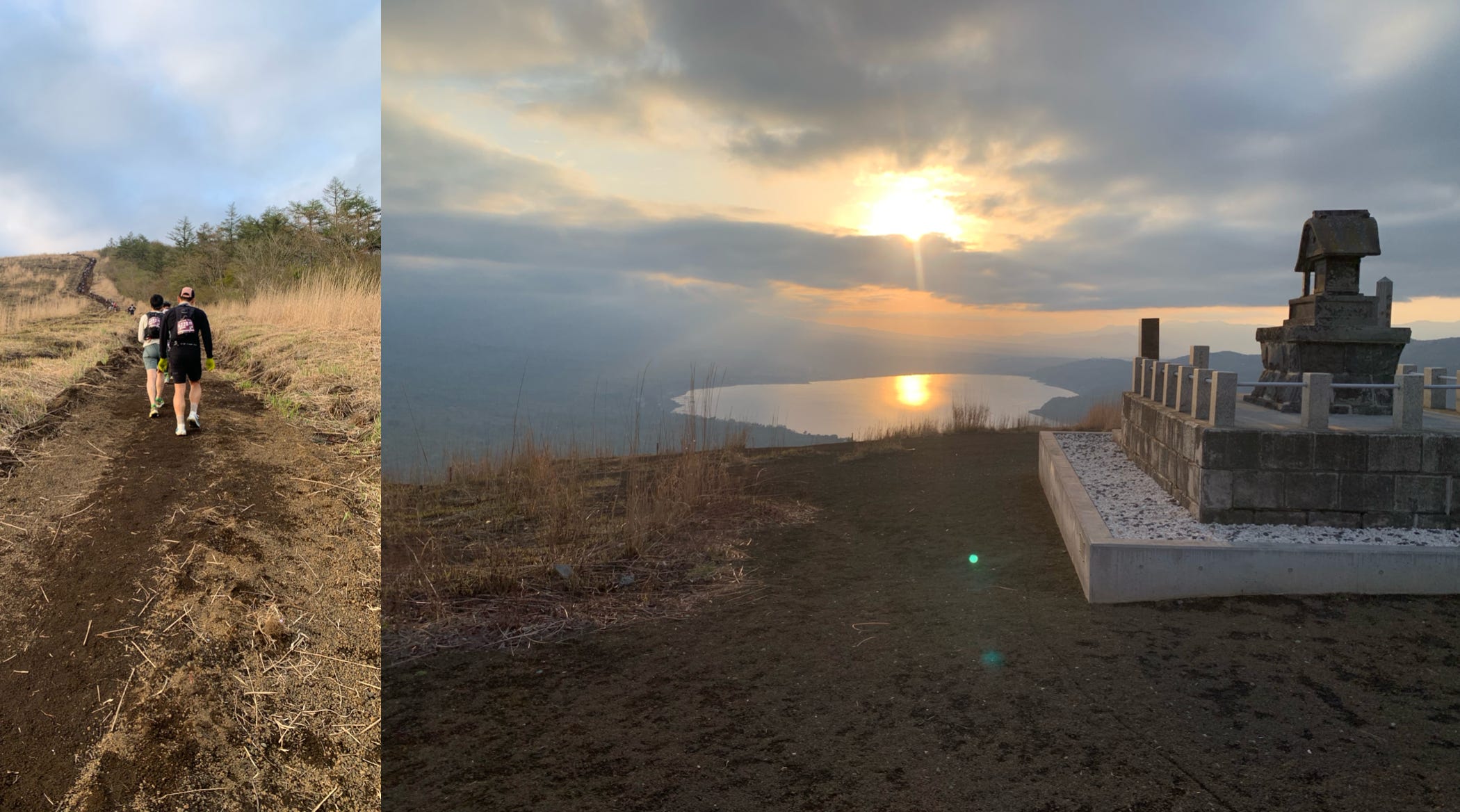
The downhill section wasn’t too bad (very runnable), and once the descent was done I found myself on a flat section of the course. It was just gravel roads at this point followed by a bit more paved road running. On one of those gravel roads I managed to meet up with a friend of mine who was running in the 100 mile division. This was very much one of the highlights of the race for me because I wasn’t sure if we would bump into each other. He seemed to be in good spirits and good physical condition, but of course we were running totally different races so we said our goodbyes and I powered on.
Once I cleared the next village area it was back onto the trails and into what was now literally a deep dark wood. This section had us climbing for about 400 meters before coming to a place called 石割り神社 (Ishiwari Shirine). This part of the course was essentially part of a slight detour due to a trail collapse before the race. The resultant detour ended up cutting 1.6 km and 152 meters of elevation from the race distance. According to the race page, this was expected to cut off about an hour from the top runners time. I found out why as we entered the next section.
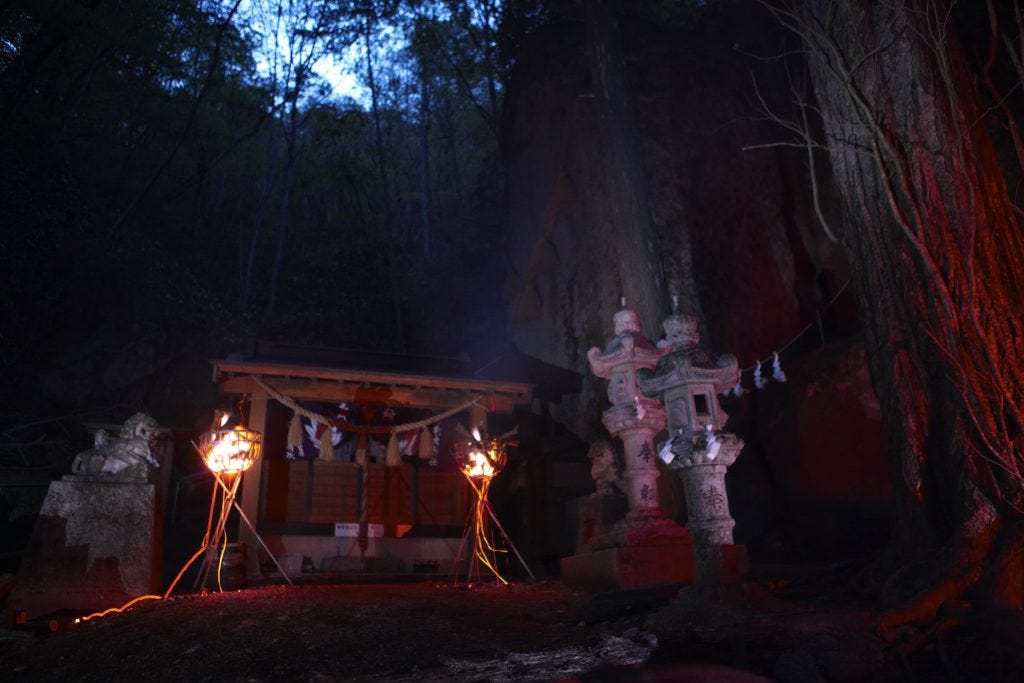
After a descent of about 200 meters (where I lost my footing a few times) I found my way to the next aid station at 二十曲峠 (Nijumagari) (38.1 km).
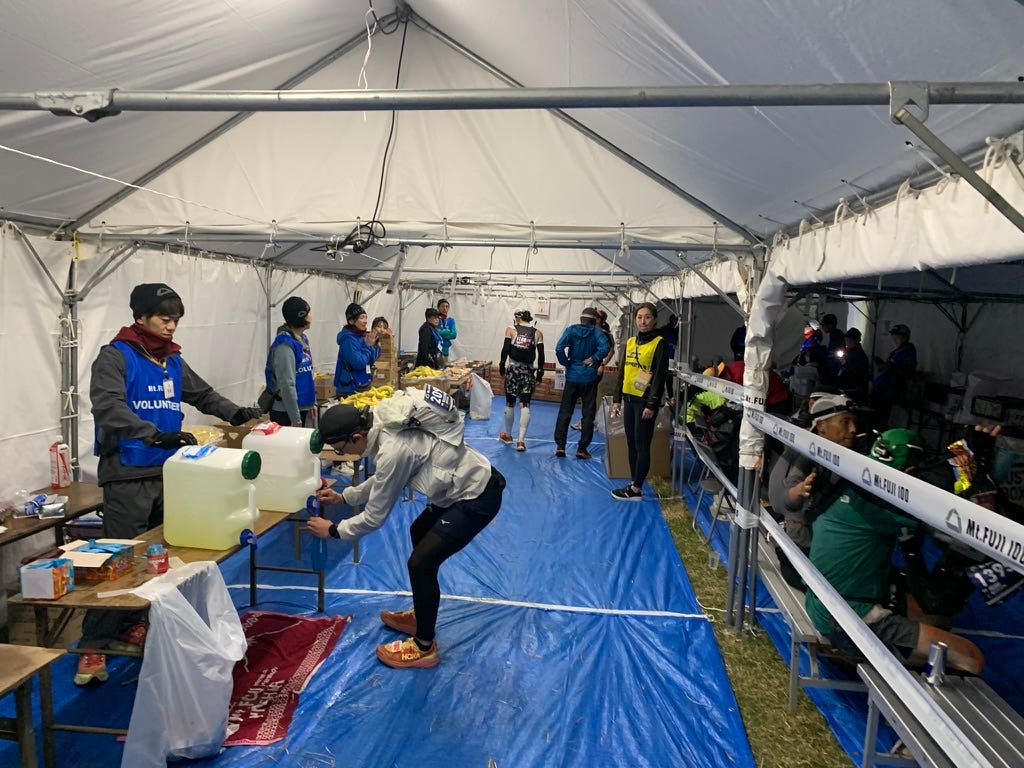
At this aid station I made sure to refuel a lot (I drank two cups of miso soup, two cans of coke, ate a lot of bread, chocolate, and fruit, and made sure to refill my water bottles with Medalist drink).
There was a saxophone player at this aid station. Every person who left the aid station was treated to a few bars of “Gonna Fly Now” from the Rocky soundtrack as they charged off into the darkness. The next section was probably the hardest part of the race.
二十曲峠 (Nijumagari) to 富士吉田 (Fujiyoshida) (49.8 km)
杓子山 (Mt. Shakushi) was punishing. There was 1 km section in this part of the course where you gained 400 meters of elevation. This changed from a trail RUN (which I signed up for) to a mountain climbing section (which I didn’t know I signed up for).
I was wearing a headlight and a wrist light at this point. The wrist light kind of got in my way at some points of the climb, but I didn’t think too much about that. I was mostly focusing on trying not to fall onto any other runners/climbers below me as I was trying to find both my footing and handholds in the middle of the night.
I eventually got to the top of this section (being very thankful that I’d been working on not just my running but also my upper body conditioning as well before this race), and then I ended up in a descending section.
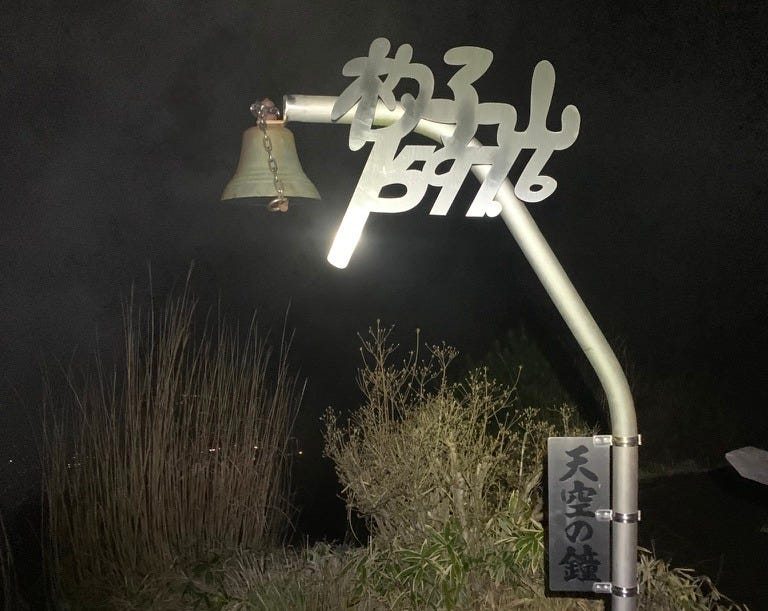
Descents on roads are something I’m very good at. Descents on trails are something I lack confidence in. Especially when I am wearing shoes that (in hindsight) didn’t have enough grip.
I fell over multiple times on these incredibly steep descents and my confidence was being damaged more than my body was at this point. I ended up tensing up a lot, which made movement more exhausting. I was still able to jog smoother sections but the steep descents were a big problem. In addition to all of this my wrist light stopped working and my headlight was also starting to fade. I could still see and had a spare one with me but it was definitely adding to my stress levels.
When things started leveling out a little bit I came to a very small road section where some volunteers were stationed to warn us of some stairs that were coming up. I had just fallen a few times on a ridiculously steep descent so I wasn’t worried about the stairs. At the very top of the staircase I pretty much rolled my ankle and fell heavily backwards landing on my backpack.
Volunteer: 「大丈夫ですか?」(Daijobu desu ka? : Are you ok?)
Me: 「…多分」(…Tabun: …Maybe)
Volunteer: 「多分?!」(Tabun?! : Maybe?!)
At this point I had not actually put any other layers on. I had my raincoat, an under layer, a light jacket, and rain trousers in my backpack, so there was enough padding to cover my spine as I landed on the steps. I stood up to see if my ankle would hold up and it appeared to be mostly uninjured. It wasn’t far to the next aid station so I thought I would just get there first and see how things went.
As I finished the descent (taking care on the stairs and the rest of the downhill parts) I saw lights ahead and heard a lot of croaking. The next aid station was next to a large pond (or small lake) that apparently have a lot of frogs in it.
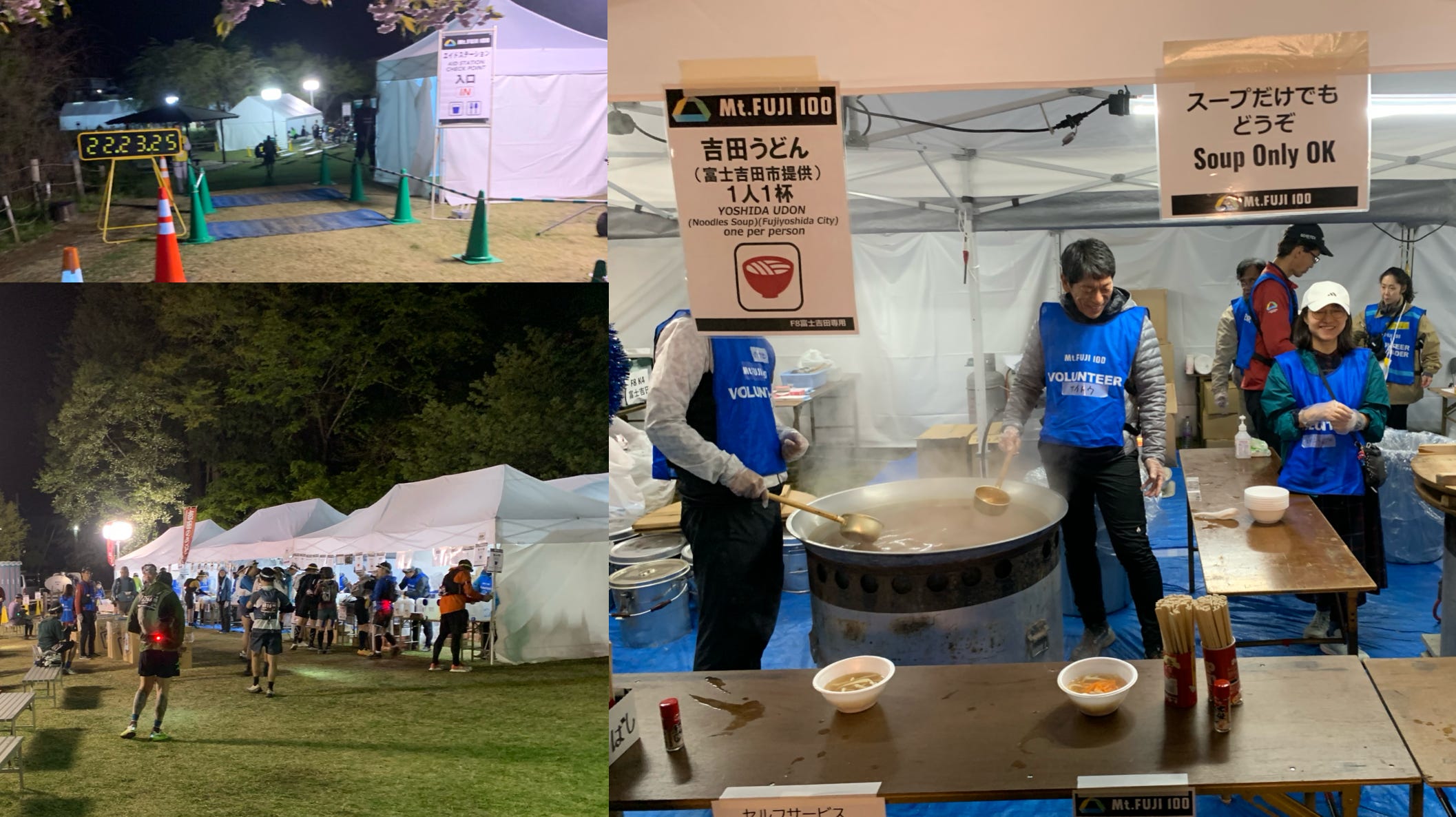
The aid station here was very pleasant. The volunteers were making a very large cauldron of udon (which I enjoyed). I also was able to get hold of an energy gel, another two cans of coke, and some bread. While I was eating my udon I plugged my main headlight into a battery pack and put it in my backpack (just in case), stowed away my useless wrist light, and got out my cheap (but reliable) standard battery powered light. This was the last aid station. Less than half a marathon to go. It was before 11 pm when I left so I was still making decent time.
富士吉田 (Fujiyoshida) to 富士山GXスタジアム (Fuji GX Stadium) (68.6 km)
After enjoying the famous Yoshida udon at the Fujiyoshida aid station, we'll tackle the final boss, Mt. Shimoyama. Once you reach the top of the winding mountain trail, the rest of the trail is a light and easy run to the finish line. Let your mind go and run while looking down at the city of Fujiyoshida spread out below.
The next section had me running through a residential area in Fujiyoshida for a while. This was a pretty easy downhill section. I ran past an apartment building and saw two volunteers stood at the entrance to the 霜山 (Mt Shimoyama) trail. I tried to jog in with a bit of swagger and said, “This must be the final boss," on the way in. I don’t think I impressed anyone.
This section was a 3 km trudge up a mountain with 600 meters of elevation gain. Literally nobody was running or jogging this section. It was a big zombie style shuffle.
On multiple occasions I heard some whistling in the woods. I thought I heard it going up Mt. Shakushi as well. I couldn’t be sure if what I was hearing was real or some kind of auditory hallucination at this point, but my mind kept drifting back to some horror stories I heard that had a warning about whistling in the woods.
“Don’t whistle back. Because if you do, it will know where you are.”
Your mind can go to weird places when you are running in the middle of the night.
This climb seemed kind of endless. I kept checking my watch and saw the remaining climb counting down. I kept splitting it down as I went along. 500 meters to go. Two thirds to go. Only 300 meters to go. Two thirds done. 100 meters to go. Almost there. Every few meters I ended up thinking of a new way of describing how much I’d done and how much I had to go. That was another place my mind took me to between the whistling.
Once I got to the top I needed to deal with the last big descent. I slipped another few times, one time being quite near a cliff, which caused my body to tense up more and made moving even harder. I was cursing my shoes at this point and started feeling quite bad for holding up people behind me.
Where I could, I let people pass me on the trail, but there were some parts around here that were VERY narrow. A foreign runner came behind me, read my name from my race number and asked how I was holding up. I told him honestly that I didn’t feel like falling off a cliff and DNFing or dying after coming this far, and he assured me I’d be ok and that a “big beer” was waiting for me at the finish line. I don’t drink, but I appreciated the encouragement.
I slowly (much more slowly than I would have liked) managed to complete the final trail descent on the course and once again found myself in a kind of residential/industrial area. The tension in my body from all the descent stress was still not leaving my body and I found it difficult to do much more than power hike around here. I managed the occasional jogging burst but most of the strategy from here was to not drop below a focused power hiking pace.
I moved around the Fuji Q Highland theme park (I really want to go on these rollercoasters someday) and found myself entering a final trail section heading towards Hokuroku park.
I was kind of expecting this section to be a little more festive as we approached the final stretch, but it seemed a bit more like a final trial. There were occasional markers on trees that counted down the final few kilometers but other than that there was nothing but darkness.
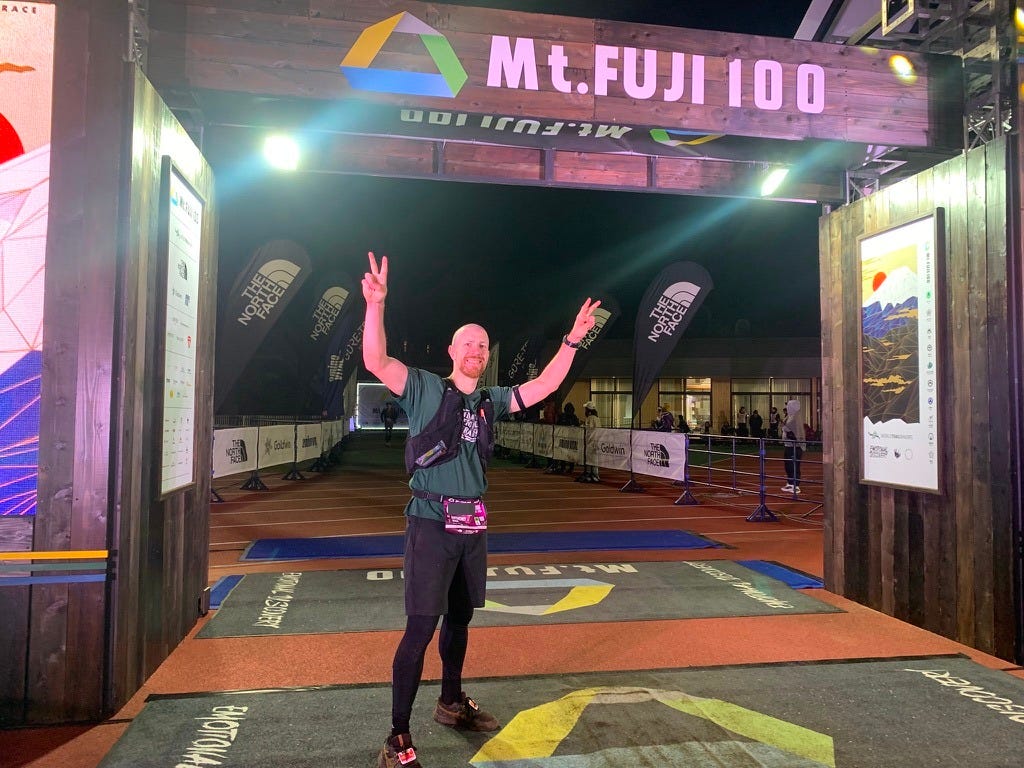
I was by myself when I entered the finisher funnel. At that point I had a nice adrenaline boost and hard charged down the runway and under the arch where the race director was waiting for me and gave me a high five as I finished the race.
After the race
It was just after 02:30 when I finished. I hadn’t noticed it was cold until after I stopped moving, so after I picked up my medal I hurried off to pick up my belongings. I put as many layers on as I could (still cold) and laid down in the hall for a short while.
After about 30 minutes of shivering and attempting to sleep, I gave up and checked my phone to see if any of my friends were on their way to the finish line. I had an app monitoring their positions and found that two of my friends were on their way to finish. I grabbed all my gear then went to meet them at the finish line.
My friend I met on the course earlier finished his 100 mile run at roughly the same time my other friend finished the 70 km division. It was great to see everyone I came with complete the race.
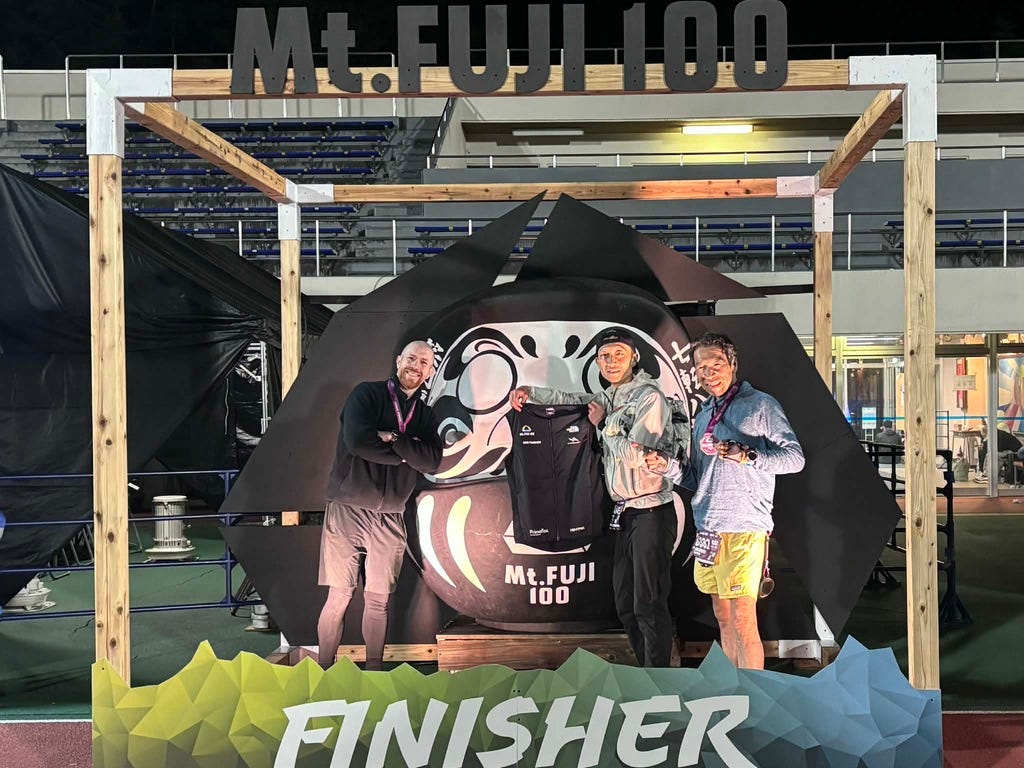
What an experience.
Race results
Below are the results I got from my Garmin. I displayed the results alongside my race medal.
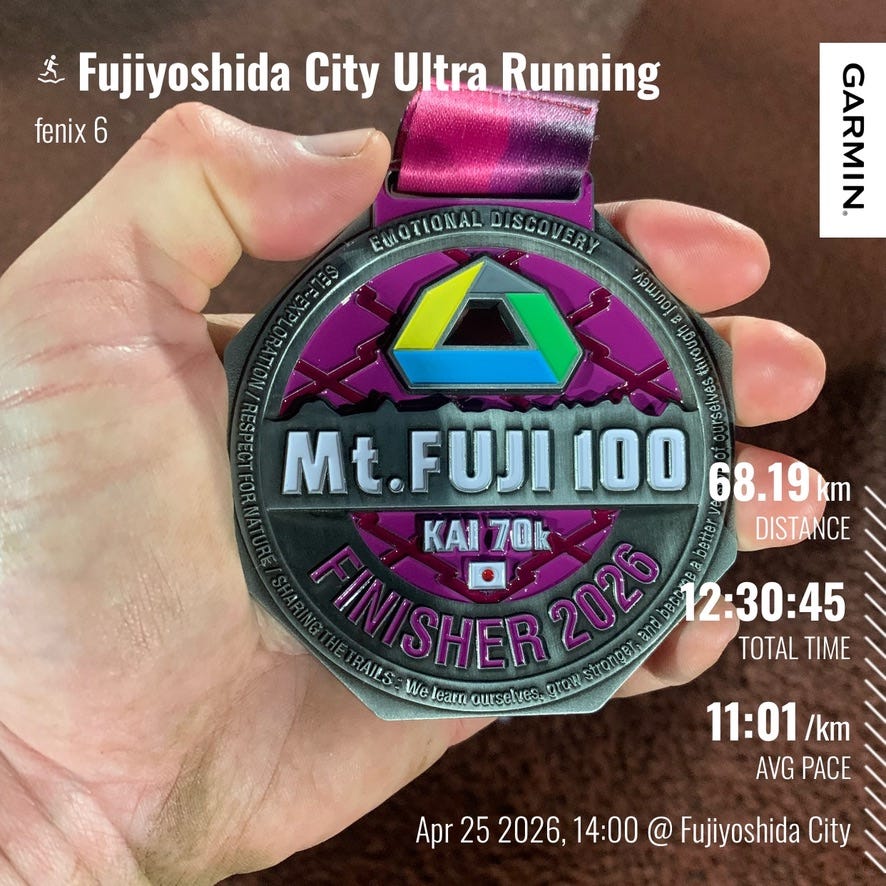
The medal itself is a cool one. I especially like the jagged design above the Mt. Fuji 100 lettering. That is the course profile for the entire 100 miler. I’m pretty sure that is just added pressure to get Kai finishers to complete the 100 miler in the future.
Final thoughts
I had a great time at this race. I know from this race that I am a much stronger runner than I was when I took on the Izu Trail Journey a while back. I do however think that I could have done much better if I had better shoes. The shoes I had were probably not appropriate for such an intense trail run and I need to get some shoes with more stable grip and field test them before attempting another race like this.
Physically I was ok on the run and could have gone much further. The mental toll from slipping and falling so many times was probably the thing that damaged me the most during the race. I wasn’t physically injured (mostly due to conditioning), but the mental strain slowed me down.
The day after the race couldn’t even really be called the day after. After I got back to my hotel I slept for one hour then spent the day in traveling around with my family who were visiting. We went to a hot spring in the afternoon (which was very welcome), and I had a great day.
Thank you for reading
Thank you very much for reading this long report. This clearly wasn’t a report written by an elite runner and wouldn’t be useful to any elite runners doing this race. However, I hope reading about my experience was enjoyable and I also hope that it will be useful to any mid-pack ultrarunners that are considering taking on the Kai in the future.
Finally, I’d like to give a special thanks to all of the organizers, staff, volunteers, and other runners of the Mt. Fuji 100. This was an unforgettable experience that wouldn’t have been possible without you.