
Appropriate use of technology
Silence, Luddites

Judging based on a single talent (or lack thereof)
When I was in primary school I got involved with music. I remember enjoying it to a level, but one of the things that totally ruined my enjoyment of it was the fact that I hated my music teacher. I don’t recall her name (nor do I want to) but I do remember a feeling of not wanting to make mistakes while playing whatever musical instrument I was obliged to play at that time, because getting it wrong would lead to a negative interaction (I didn’t like being yelled at over an extracurricular activity). I played music during my primary school years (initially because I wanted to, but eventually because I felt obliged to), and as soon as I reached secondary school I dropped it. No point carrying on something I had no love for.
When I was in secondary school I was very focused on working on science. I saw very little value in art class, and as such I put almost no effort into it. I enjoyed doing technical drawing (and took graphic design as one of my subjects), but I didn’t like free hand drawing things because I didn’t see a future in it.
I also didn’t care much for the, “modern foreign languages,” I was obliged to study at school. I was obliged to learn French and German, but again, back when I was in secondary school, I just wanted to work on my science projects and not get involved with French and German. (I wasn’t planning on moving to France or Germany in the future and to this day I have still not set foot in Germany).
As with everyone, as I got older, I ended up getting more and more specialized. Now that I am old enough and have decades of experience in multiple fields, I have figured out what I’m good at an what I’m kind of terrible at:
Good at science
Good at Japanese
Good at martial arts
Terrible at drawing
Terrible at music
I have discovered as I’ve gained more experience that although I’m not so good at foreign languages that aren’t Japanese, I can learn if I put my mind to it. I did ok in France last year after taking a French course, so I could probably be decent at drawing and music IF I put a lot of effort into it (which I don’t really have time to do).
But recently there has been a bit of a fuss on social media over the use of AI art. There are several people (usually people who think they are talented artists but who only seem to have about 100 or so followers online) that are cursing anyone who dares to use “AI slop” instead of paying someone talented (them I assume) to do the art for them.
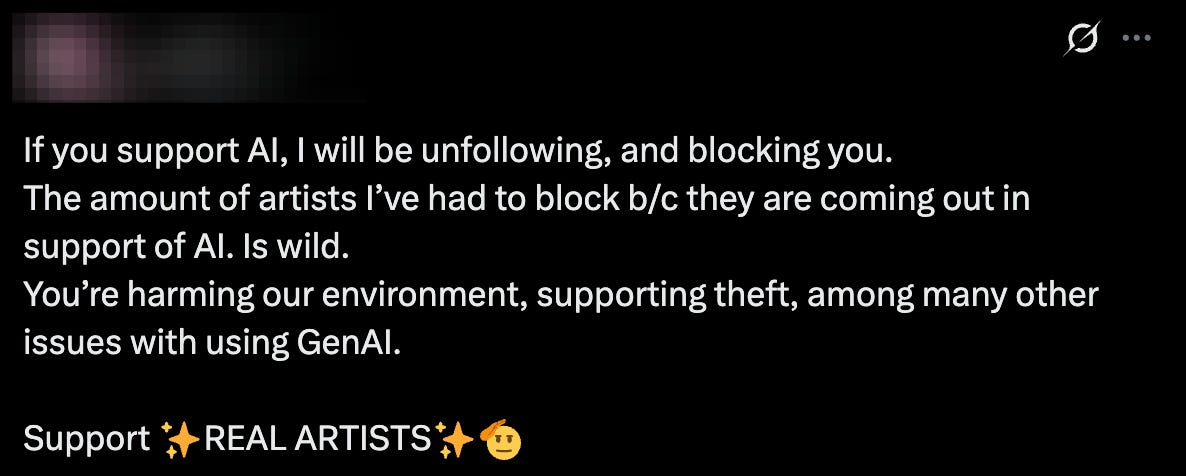
Let’s take a look at this.
The modern technology we surround ourselves with
It could be said that people in current year are not as good at penmanship as the previous generation. These days, I do far more typing than I do writing by hand.
Being an iaidō practitioner, I have a lot of friends who are in the older generation (in their 70’s and beyond). In recent years some of those people have started to get involved with instant messaging apps, but in the past I have had instructors pass me notices in the form of hand written letters with beautiful penmanship and no mistakes.
I know that whenever I type I see red lines appear under the text that I write to let me know that my spelling is incorrect. I am constantly typing, deleting, checking, and retyping whenever I put together an article. There’s a lot of automation involved with using a word processor even in my native language.
Many Japanese people also do the same thing in Japanese. It is not uncommon to come across people who can read words like 薔薇 (bara: rose) or 麒麟 (kirin: giraffe/Chinese unicorn), but can’t actually write the characters by hand.
And while I wouldn’t call a word processor an AI, I would say that it’s a modern tool we all use on a regular basis to make writing/typing easier (while also making up for our shortcomings of not knowing how to spell every word and write every kanji).
Additionally, AI translation is becoming more and more widespread. It’s also becoming much more sophisticated the more it is trained. A few years ago, if you wanted a translation doing right you needed to involve a qualified translator who could understand the nuances of both languages in order to get the point across, which was often and expensive and time consuming process. Now we can get the gist of what is being said at the touch of a button with an AI translator.
Going a step further, just last week I was in a rush to get something done for a seminar I was involved in, but I was very short on time. With a couple of prompts, I managed to get the AI to come up with a curated list of backup questions for the seminar (just in case there was time at the end) and also come up with an Excel based sign-in sheet for people attending the seminar. Stuff I could have made myself if I had an hour or two to spare, but stuff I was able to get done instantaneously thanks to AI.
We are now living in a world where this kind of technology exists. Not accepting it means we are falling behind.
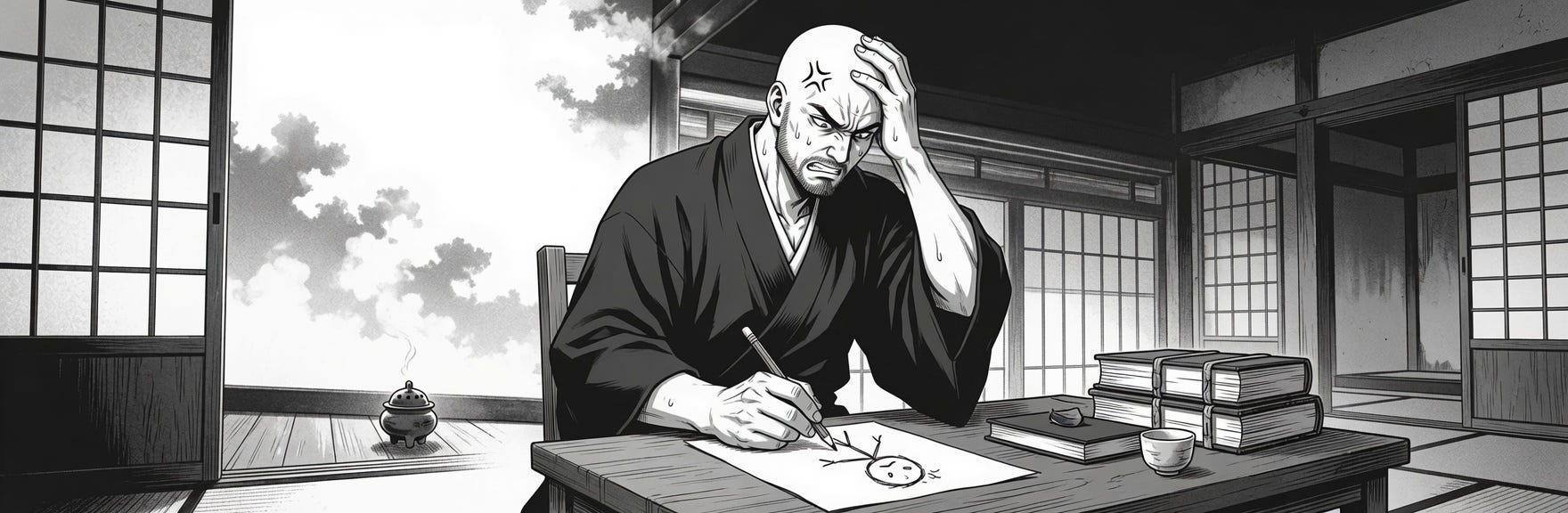
Also, as previously stated, I am not good at drawing…but I can use an AI tool to “illustrate” how bad at drawing I am.
The double standards
As I mentioned earlier, I’m seeing a lot of people online who are whining about “AI slop,” when it comes to art. But these people are all posting on social media and are existing in the same environment as everyone else.
So the “artists” who get angry at people for using AI are probably using at least some, if not most of the following things without thinking (this list was partly made using Grok):
Spell checkers & grammar tools (Word processors)
Autocorrect & predictive text (phone keyboards)
Autocomplete / smart compose (Gmail, messaging)
AI translation (Google Translate, DeepL)
Google/Apple Maps (routes, traffic prediction)
Auto-generated video captions & subtitles
Fitness tracker activity recognition
You might think I’m being ridiculous, but if someone is taking a hard line stance on AI by saying, “AI is taking our jobs away, so you shouldn’t use it,” then why aren’t they doing exactly the same when it comes to these things?
Why are you using word processing tools instead of hand writing it and giving it to a typist to proof read and type up? You are taking a typist’s job away.
Why are you using a map application instead of hiring a guide? You are taking a guide’s job away.
Why are you using a fitness tracker instead of hiring a personal trainer? You are taking a personal trainer’s job away.
Why does this only apply to drawing?
Modern Luddites
Back when I was in school I remember learning about Luddites. For the purpose of this article, I did not go to a library, pick up a book on 19th century British history and then write my findings here. I simply looked it up online using modern technology.
Luddites were a group of 19th-century English textile workers who protested against automated machinery and the industrialization of their craft. Today, the term broadly describes anyone who opposes, mistrusts, or avoids new technological changes.
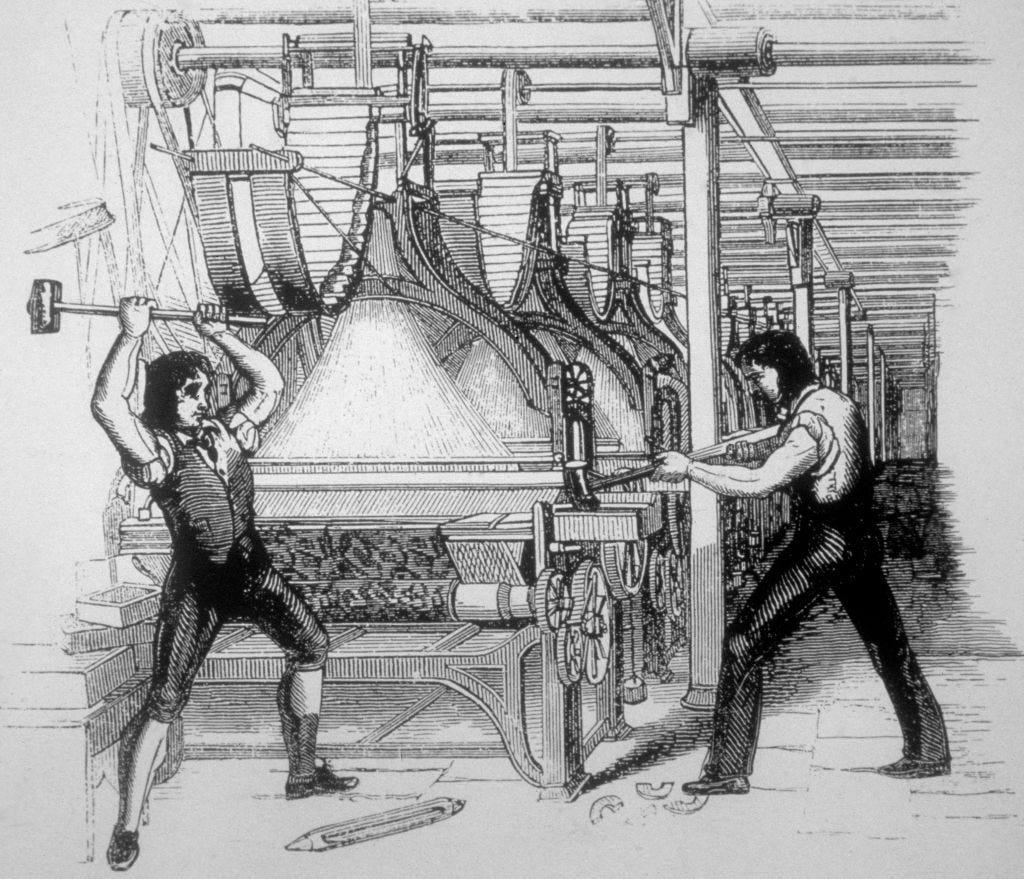
During the industrial revolution, machines like looms and knitting frames were introduced in order to speed up the process of textile manufacturing. Some of the people who originally did this by hand felt like their livelihood was being threatened by this new technology started sending aggressive messages to people who adopted it to get them to stop (sound familiar?) or even started actively destroying the machines that were, “taking their jerbs.”
Things eventually didn’t end well for the Luddites after their activities were criminalized (leading to multiple hangings), and as you might notice technology has moved far beyond weaving machines now.
The people who are anti-AI to the point they are being unpleasant and threatening to anyone who has any level of appreciation for AI art (specifically) are clearly acting like Luddites, only without realizing how much of their lives have already been handed over to modern tools anyway. So far I haven’t received any aggressive hand written letters. It is always in the form of word processed comments online.
Augmented Intelligence
I am not a big fan of the term, “Artificial intelligence.” I much prefer the term, “Augmented intelligence.” I use tools in order to enhance what I can do. I don’t just throw anything and everything to AI and have total reliance on it.
I might use tools to improve my typing (like we all do), but unless I proof read it first I might just end up writing a bunch of nonsense. I might use a translation tool to get the rough gist of something, but if I want a proper translation, I will go to a bilingual human to make sure it’s correct (or check it myself if it’s in a language I understand). I might use a map app in order to find my way around, but if I use the map app as a tool I might still get lost and might actually increase my chances of being hit by a car. And I might ask an AI to draw something for me due to my lack of individual artistic ability, but if I am not happy with what has been produced I’ll either remake it until I’m happy with it or speak to an actual artist who can do it well for me.
I use my own ability plus AI augmentation in order to get things done. That is how it should be done. Having this singular exception for “art” doesn’t make sense to me.
Final thoughts and take home messages
We all have stuff we are good at and we all have stuff that we are not so good at. I spent a lot of my life working on things I wanted to be good at, and as a result I didn’t have time to also master things like musical instruments and fine art.
We live in a world where we are surrounded by modern technology that makes everything easier. Even word processors are an example of this. But to some people the only thing that matters is whether you can draw or not.
If you are against people using AI to create drawings or pictures and demand that they stop on the grounds that it threatens jobs, are you going to stop using AI tools that are taking jobs away from others? Professional translators would probably appreciate it if you stopped using AI translation tools give the work to them instead.
I won’t be stopping using AI to augment what I do any time soon. I’m not a Luddite. Embrace technology or be left behind.
And just as a last thought, technology is cool. That doesn’t mean it is going to literally replace everything. I can appreciate the fact that Yaskawa trained an industrial robot to use a sword while still appreciating traditional swordsmanship. It doesn’t replace traditional swordsmanship in the same way that AI art doesn’t replace art. People can appreciate the modern and the traditional at the same time.
Thank you very much for reading. If you enjoy my work please share it with someone you think would also enjoy it.
If you aren’t subscribed, please sign up to keep up to date.
If social media is more your thing I’m active on Facebook, and Instagram.
And if you are feeling generous but don’t want to commit to a monthly subscription, you can send a small donation to my Buy me a coffee page below.
